

Product Field NotesCompanion Plants
Firefly Red Pop Yarrow: Cherry Red Over Silvery Leaves
 Save
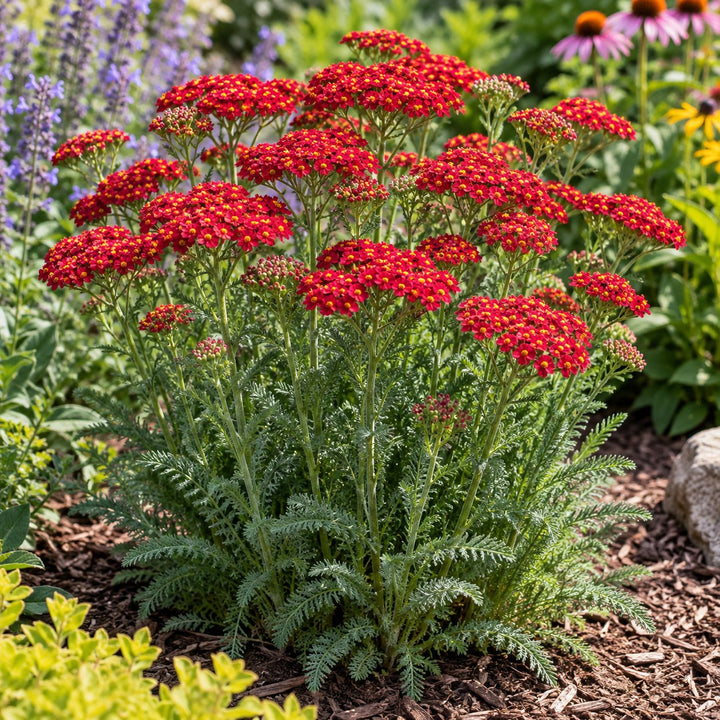
Firefly Red Pop yarrow carries flat clusters of bright cherry red florets, each with a tiny yellow center that gives the head a speckled look. They sit above silvery green, finely cut, feathery leaves, and that contrast between red flowers and pale foliage makes the plant easy to spot from across the garden.
It grows into a sturdy, upright clump 24 to 28 inches tall and wide and was selected as a standout in university plant trials. Bees and butterflies visit often, while deer and rabbits usually pass it by.
Red Pop at a glance
| Trait | What to expect |
|---|---|
| Botanical name | Achillea 'Firefly Red Pop' |
| Flowers | Cherry red with small yellow eyes, clusters 3 to 4 inches |
| Foliage | Silvery green, finely divided and soft |
| Bloom | Starts mid-June, peaks early July, repeats after shearing |
| Size | 24 to 28 inches tall and wide |
| Hardiness | USDA zones 3 to 8 |
| Light | Full sun |
| Wildlife | Excellent for pollinators; deer and rabbits usually avoid it |
The silver connection
Red Pop's silvery leaves are what make it such a good lavender companion. They pick up the gray-silver of lavender foliage, so the two plants look related even when only one is blooming. Then, in early to midsummer, the cherry red flowers land right beside the purple spikes for a bold, confident contrast. Red and purple can clash in some gardens, but the silver foliage on both plants ties them together.
Use it in groups of three between lavender clumps, or as a band of red in front of a lavender hedge. Like lavender, it stays sturdier and more compact in lean soil. Sketch the layout in the Companion Plant Planner.
Planting and care
- Site: full sun with lean to average, well-drained soil.
- Water: regular the first season, then only during long dry spells.
- Deadheading: older flowers soften in color. Shear stems back by about half after the first flush for a second round.
- Disease: few problems; mildew and rot show up mainly in wet, crowded or poorly drained sites.
- Winter: reliably hardy in Michigan. Cut spent stems to the basal foliage in fall or spring.
Cutting, drying and containers
Red Pop is good for cutting and drying, and it adds a jolt of color to dried arrangements alongside lavender. Its compact size also suits large containers on a sunny patio, as long as the mix drains quickly. Prairie plantings are another good fit, where its red heads punctuate grasses and native flowers.
Plug tray or bare root
Red Pop is offered as a 72-cell plug tray for growers and larger plantings, and as a bare root plant for home gardens. See each product page for current availability.
Frequently asked questions
Does the red fade?
Older flowers soften in color as they age. Shearing after the first flush brings fresh, bright heads.
Will it spread through my lavender?
It forms a sturdy, upright clump rather than running. Divide it every few years if it outgrows its spot.
Is the foliage scented?
Yes, it has a sharp, herbal aroma when brushed.

































Share how it went in your field