

Product Field NotesCompanion Plants
Paint the Town Magenta Dianthus: A Long Season of Bright Pinks
 Save
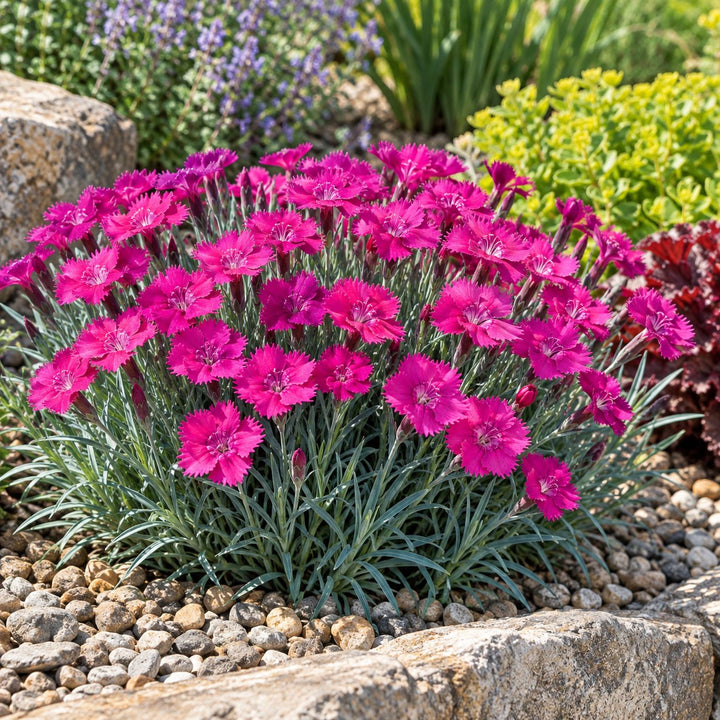
Paint the Town Magenta dianthus is the vivid one of the series. Its small single flowers, three-quarters to 1 inch across, come in a vibrant magenta pink with fringed, coarsely toothed petals, and they arrive so thickly that the blue mound underneath simply vanishes. It is early to start and slow to quit, flowering from late spring well into mid-fall when it is happy.
Paint the Town Magenta at a glance
| Trait | What to expect |
|---|---|
| Botanical name | Dianthus 'Paint the Town Magenta' |
| Flowers | 0.75 to 1 inch, vibrant magenta pink with fringed petals |
| Fragrance | Light, sweet and spicy, clove-like |
| Foliage | Glaucous blue-green, semi-evergreen |
| Size | 6 to 8 inches tall, 12 to 14 inches wide |
| Bloom | Starts early in the season, peaks mid-June, continues into fall |
| Hardiness | USDA zones 4 to 9 |
| Wildlife | Good for pollinators; moderately deer resistant |
Built for the rock garden
If you have a sunny slope, a stone wall or a gravel garden where lavender already thrives, this is the dianthus to tuck in beside it. Low mounds of blue foliage settle into crevices and soften hard edges, and the magenta flowers glow against gray stone. Both plants appreciate the warmth and fast drainage that rocks provide, and neither wants rich soil.
Against lavender, magenta gives a punchier contrast than softer pinks. Use it in bold drifts at the base of a lavender hedge or alternate small groups with lavender along a path. The Companion Plant Planner lets you test the combination first.
Keeping it blooming
- Shear lightly after the first big flush to tidy the mound and push more flowers.
- Expect a midsummer pause. Bloom slows in the hottest weeks and picks up as nights cool.
- Do not overwater. Soil that dries between waterings keeps roots healthy; wet, heavy soil invites crown and root rot.
- Skip the fertilizer. Lean ground keeps the mound dense, the same as it does for lavender.
Through the winter
The foliage is semi-evergreen and reliably hardy in Michigan when drainage is sharp. Winter wetness, not cold, causes most losses, so keep mulch off the crown and plant on a slight rise if your soil holds water. In spring, trim off any leaves that winter browned and new growth fills in quickly. Check your zone with the USDA Zone Finder.
Frequently asked questions
How long does it really bloom?
The heaviest show is late spring to early summer, with lighter, steady flowering into mid-fall after a light shearing.
Is it good for pots?
Yes. Its compact mound works in mixed containers and troughs with a gritty, fast-draining mix.
Will bees visit?
It has a good pollinator rating, so expect bees and butterflies alongside those on the lavender.

































Share how it went in your field