

Product Field NotesCompanion Plants
Sugar Buzz® Rockin' Raspberry Bee Balm: Deep Color, Dark Leaves
 Save
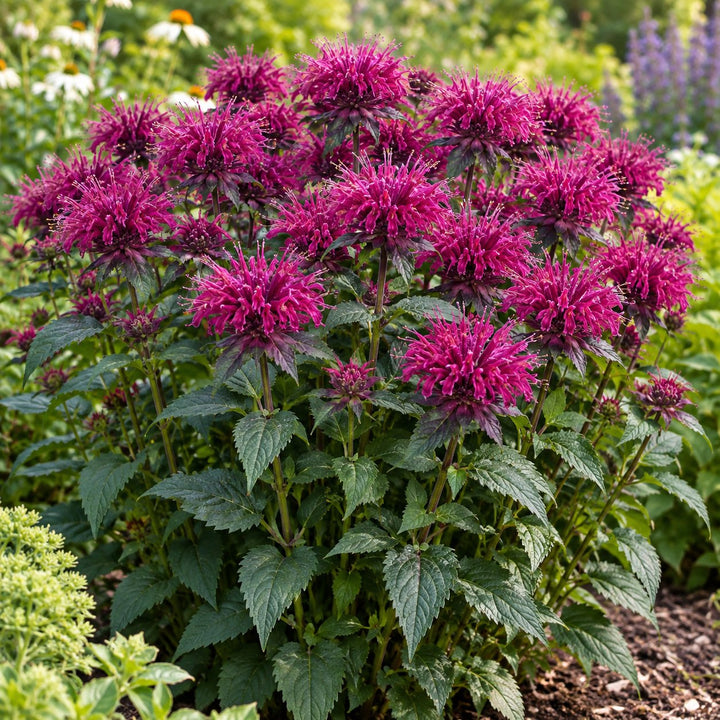
Sugar Buzz® Rockin' Raspberry bee balm pairs deep raspberry-purple flower heads with very dark green, almost black-green leaves for a rich, saturated look. Young foliage comes in tinted grayish purple, so the plant has color before it even blooms.
It also has a trick: secondary flower heads rise above the first ones, which lengthens the display.
Rockin' Raspberry at a glance
| Trait | What to expect |
|---|---|
| Botanical name | Monarda 'Sugar Buzz Rockin' Raspberry' |
| Flowers | Deep raspberry purple, 2 to 2.5 inches, on dark bracts |
| Foliage | Very dark green; new growth grayish purple |
| Size | About 20 inches tall and 20 inches wide |
| Bloom | Starts early July, peaks mid-July, long blooming |
| Hardiness | USDA zones 4 to 8 |
| Light | Full sun to part shade |
| Wildlife | Excellent for pollinators; deer resistant |
A jewel-toned partner for lavender
If your taste runs to deep, moody color, this is the bee balm to grow near lavender. Raspberry purple sits next to lavender purple on the color wheel, so the two blend into a rich, tonal band rather than a contrast. The dark foliage gives the silver-gray lavender something to glow against.
Keep the soil needs separate. Bee balm prefers richer, more evenly moist ground, so set Rockin' Raspberry in the neighboring bed and let lavender keep the dry, sunny side. For a little brightness in a dark scheme, add a white-flowered companion between the two. The Companion Plant Planner makes trying color schemes easy.
Growing tips
- Water: regular, especially through summer dry spells. Drought stress makes powdery mildew worse.
- Mildew: it showed strong powdery mildew resistance in trials; airflow and watering at the soil line help further.
- Longer bloom: deadhead the first heads once they fade so the secondary heads stay the star.
- Dividing: spreads by shallow rhizomes without spreading aggressively. Divide in spring every two to three years.
- Winter: very hardy in Michigan. Cut back in fall or leave stems until spring.
Scent and uses
The foliage is strongly aromatic when brushed, with a pleasant lemony scent. The leaves and flowers are edible and used for herbal tea or as a garnish, like other bee balms. In a vase, the deep raspberry heads look striking with silver foliage or fresh lavender stems.
Plug tray sizes
Rockin' Raspberry is offered in 72-cell and 20-cell plug trays. See each product page for current availability, or the Wholesale Hub for tray orders.
Frequently asked questions
Is it a good container plant?
Yes. At about 20 inches tall and wide, it fills out a container without spreading aggressively.
Why are the new leaves purple?
Young foliage is heavily tinted grayish purple, then matures to very dark green.

































Share how it went in your field