

Product Field NotesCompanion Plants
Bleeding Heart: The Old-Fashioned Spring Classic for Shade
 Save
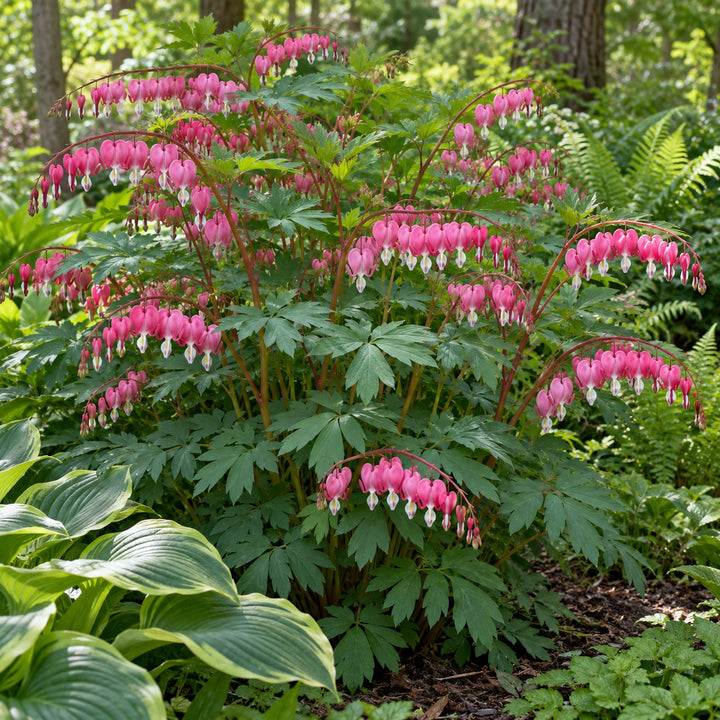
The old-fashioned bleeding heart is a classic of the spring shade garden. In May, long arching stems carry rows of 10 to 15 puffy, rose-pink hearts, each with a white drop hanging from its tip, dangling like charms above soft blue-green foliage. It holds a Royal Horticultural Society Award of Garden Merit.
It is a shade plant, so in a lavender garden it lives on the opposite side of the house, where it gets to be the star of spring.
Bleeding heart at a glance
| Trait | What to expect |
|---|---|
| Botanical name | Lamprocapnos spectabilis |
| Flowers | Rose-pink hearts with white tips, about 1 inch long |
| Foliage | Soft blue-green, deeply lobed |
| Size | 30 to 36 inches tall and wide |
| Bloom | Starts early May, peaks mid-May, several weeks |
| Hardiness | USDA zones 3 to 9 |
| Light | Part to full shade |
| Deer | Resistant |
An honest fit with lavender
Bleeding heart and lavender want nothing in common. One loves shade and moist, rich soil; the other loves sun and dry, lean soil. They are companions only in the sense of a whole-property plan. Lavender takes the open, sunny ground. Bleeding heart takes the shade under trees, along a north wall or in a woodland bed.
The payoff is timing. Bleeding heart blooms in May, long before lavender colors up, so your garden has a showpiece in spring and another in summer. Use the Companion Plant Planner to map sun and shade.
Planning for summer dormancy
This surprises new growers every year: by midsummer, bleeding heart usually yellows and goes dormant until next spring. It is not dying. Dormancy comes earlier in hot, dry or sunny sites, and steady moisture and shade delay it.
Plan for the gap by planting hostas, ferns, hardy geraniums or sedges around it. As the bleeding heart fades, their leaves fill the space. Mark the spot so no one digs into the dormant crown later in the year.
Planting and care
- Soil: humus-rich, evenly moist and well drained.
- Spring water: keep it watered to hold the foliage longer.
- After bloom: let the foliage fade naturally; it feeds next year's growth.
- Winter: very hardy in Michigan. A light leaf mulch is helpful.
All parts contain alkaloids and are toxic if eaten, and the sap can irritate skin, so wear gloves when handling and plant away from curious pets.
For the vase
The flower sprays last about two weeks in a vase. Cut stems when a few hearts at the base have opened.
Frequently asked questions
Why did my bleeding heart disappear in July?
It went dormant, which is normal. It will return next spring.
Can it grow in sun?
Sun pushes it into dormancy faster. Part to full shade is best.
Do deer eat it?
It is rated deer resistant.

































Share how it went in your field