

Product Field NotesCompanion Plants
Blue Glow Globe Thistle: Steel-Blue Spheres Behind a Lavender Row
 Save
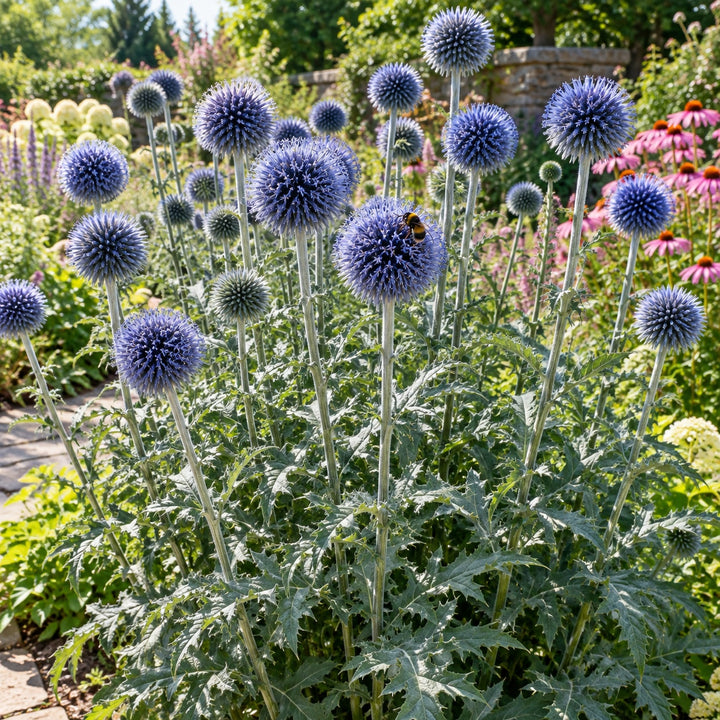
Blue Glow globe thistle sends up perfectly round, steel-blue flower balls about 1½ inches across, each one alone at the tip of a tall, stiff stem. The spheres look spiky but are softer to the touch than you would expect. Underneath, deeply cut, silvery green leaves form a bold basal clump.
Bumblebees, butterflies and night-flying moths all line up for it. In bloom it looks a little like a garden designed by a science fiction illustrator, in the best way.
Blue Glow at a glance
| Trait | What to expect |
|---|---|
| Botanical name | Echinops bannaticus 'Blue Glow' |
| Flowers | Round steel-blue globes about 1½ inches across |
| Foliage | Deeply lobed, silvery green above, woolly beneath |
| Size | 3 to 4 feet tall, about 2 feet wide |
| Bloom | Starts early July, peaks late July, showy for weeks |
| Hardiness | USDA zones 3 to 8 |
| Light | Full sun to light shade |
| Wildlife | Excellent for bees and butterflies; deer resistant |
A tall partner with matching tones
Blue Glow's silvery leaves and steel-blue globes echo lavender's gray foliage and purple-blue flowers, so the two look like they were chosen together. The difference is height and shape. At 3 to 4 feet, the globe thistle rises well above an English lavender row, adding a second layer of blue that floats over the purple.
Both plants want sun and lean, well-drained soil, and both dislike wet feet. Blue Glow colors up in July with the lavender and stays showy for weeks after. It clumps without spreading aggressively, so it will not crowd the lavender in front of it. Leave enough space between rows for air to move.
Planting and care
- Planting: set the bare root plant where you want it long term. Its deep taproot makes it hard to move later.
- Soil: average to lean with good drainage. Wet winter soil is the main cause of loss.
- Water: regularly until established, then rarely; the taproot carries it through hot, dry spells.
- After bloom: cut stems to limit self-seeding. Cutting the first heads can bring smaller secondary globes.
- Winter: very hardy in Michigan in well-drained soil.
Fresh and dried arrangements
Blue Glow is rated excellent for both fresh and dried use. For drying, cut the globes just before the tiny florets open, when the color is strongest, and hang them upside down in a shaded, airy spot. They hold their steel-blue color well and make a natural partner for dried lavender bundles. Gloves help, since the leaves look and feel a bit prickly.
Frequently asked questions
Is globe thistle invasive?
It forms a clump and does not spread aggressively by roots. Cutting spent heads limits seedlings.
Can I move it later?
It is difficult once established because of the deep taproot, so pick its spot carefully.
Do deer eat it?
It is rated deer resistant.

































Share how it went in your field