

Product Field NotesLavender Plants
Blue Mountain Lavender: A Mid-Century English Classic
 Save
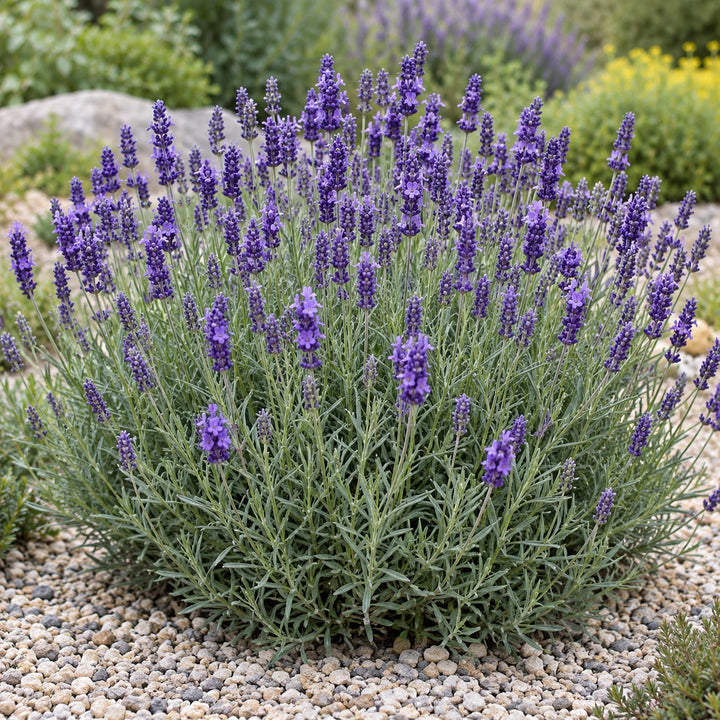
Blue Mountain lavender has been in gardens since the mid-1950s, and it has stayed for good reason. Its vibrant violet flowers have a paler center that gives each spike a little sparkle, and the fragrance is sweet and floral with soft herbal notes and very little camphor bite.
It is an English lavender, Lavandula angustifolia 'Blue Mountain', with a tight, uniform habit that keeps it looking neat from the first leaves of spring to the last flowers of late summer.
Blue Mountain at a glance
| Trait | What to expect |
|---|---|
| Botanical name | Lavandula angustifolia 'Blue Mountain' |
| Introduced | Mid-1950s |
| Flower color | Vibrant violet with a paler center |
| Foliage | Gray-green |
| Habit | Compact, tight and uniform |
| Mature size | About 24 inches tall and 36 inches wide |
| Stems | About 10 inches |
| Bloom | Starts early June, peaks mid-July, repeat blooms into late summer |
| Hardiness | USDA zones 5a to 11a |
| Fragrance | Strong, sweet and floral with low camphor |
Why an older cultivar still makes the cut
New lavenders arrive every year, but a variety that has been grown for roughly seventy years has proven itself in a lot of gardens. Blue Mountain combines the qualities most home growers care about: a dependable, tidy shape, a long season of color, a sweet scent and excellent ratings for both fresh bouquets and dried flowers.
Its uniform growth makes it a good pick for a low hedge or a repeated planting where you want every mound to match. Bees and butterflies visit heavily, and deer tend to look elsewhere.
Getting it planted right
Full sun and drainage are the whole game with lavender. Pick a spot with at least six to eight hours of direct sun and soil that never stays soggy. If your ground is heavy clay, plant on a raised mound or in a raised bed instead of amending a single hole, which can turn into a bathtub.
Plan for a mature width of about 3 feet. For a continuous hedge, set plants a little closer, around 30 inches, so the mounds just touch. Keep the crown at soil level and keep mulch away from it. English lavenders need a winter chill to bloom well, which Michigan provides generously.
A season with Blue Mountain
- Early spring: look for new growth before removing any winter-damaged tips.
- June to July: the main show. Cut for bundles as buds color up.
- After the first flush: shear spent stems and a little leafy growth to set up a late-summer rebloom.
- Late summer: enjoy the second round, then leave the plant alone until spring except for light tidying.
- All year: water only during establishment and long droughts, and skip the fertilizer.
The Pruning Calendar and Care Calendar lay out the timing.
From the garden to the kitchen and the drying rack
Blue Mountain carries a great culinary rating, and its low-camphor scent hints at why: the flavor leans sweet and floral rather than sharp. Harvest for cooking when buds are colored but before most flowers open, dry them in the shade and rub them off the stems. Use only buds from plants grown as a food crop, and start small.
For bundles, its 10-inch stems are a tidy length for small bouquets, sachets and wreath work. Cut on a dry morning and hang bunches upside down in a dark, airy place to hold the violet color.
Choosing a size
Blue Mountain is listed as a 3-inch plug, a 4-inch pot or a 1-gallon pot. Plugs are a smart, economical way to plant a hedge; gallon pots fill a key spot quickly. See the product page for current sizes and availability, and use Notify Me if it is not ready yet.
Frequently asked questions
Is Blue Mountain good for cooking?
Yes. As an English lavender with a sweet, low-camphor profile, it is rated great for culinary use. Use food-intended buds and a light hand.
Will it really rebloom?
It has moderate rebloom. A light shearing after the first flush usually brings a smaller second round in late summer.
How does it compare with Hidcote or Munstead?
All are compact English lavenders. Blue Mountain stands out for its paler flower centers and long season. Line them up in the Compare tool.

































Share how it went in your field