

Product Field NotesLavender Plants
Blushing Bride Lavender: Soft Pink in a Petite Mound
 Save
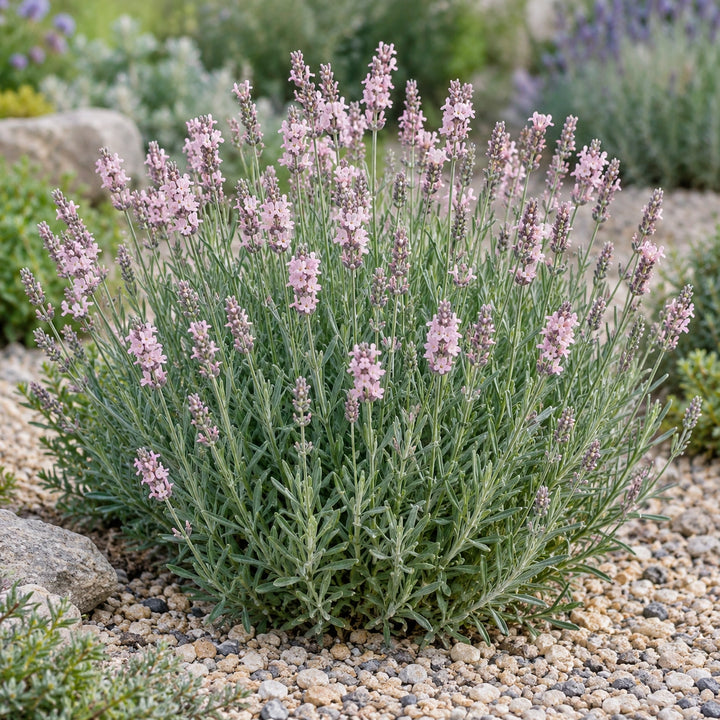
Blushing Bride lavender trades the usual purple for a soft pink. It forms a compact, bushy mound of gray-green foliage about 15 inches tall and wide, and in early summer it covers itself in pink spikes with a strong, sweet lavender scent. It is proof that lavender does not have to be lavender-colored.
Botanically it is an English lavender, Lavandula angustifolia 'Blushing Bride', so it brings the hardiness and the culinary quality the group is known for, just in a gentler color.
Blushing Bride at a glance
| Trait | What to expect |
|---|---|
| Botanical name | Lavandula angustifolia 'Blushing Bride' |
| Flower color | Pink |
| Foliage | Gray-green |
| Habit | Compact and bushy |
| Mature size | About 15 inches tall and 15 inches wide |
| Bloom | Starts early June, peaks mid-June, moderate rebloom |
| Hardiness | USDA zones 5a to 8b |
| Fragrance | Strong, sweet and floral with low camphor |
| Culinary rating | Great |
Designing with pink lavender
Pink lavender reads softly from a distance, so place Blushing Bride where people will see it up close: in a pot by the door, along the front edge of a bed, or lining a walkway. It shines in pastel color schemes with white lavenders, pale blue flowers and silver foliage, and it makes a lovely contrast tucked between deep purple cultivars.
Its early-June peak also makes it a natural for gardens planned around early summer gatherings, from graduation parties to garden weddings. It is a great pollinator plant and deer tend to leave it alone.
Planting it well
Choose full sun, six to eight hours or more, and soil that drains quickly. Sandy loam is ideal. In clay, plant in a raised bed or mound the soil several inches above grade. Space plants about 15 to 18 inches apart so they just touch at maturity.
As an English lavender, it needs a winter chill to bloom well and is among the hardier lavenders. In containers, use a gritty mix in a pot with a drainage hole. Unsure of your zone? Try the USDA Zone Finder.
Keeping it tidy and blooming
- Water: deeply during the first season when the top few inches dry. Established plants need little.
- Feeding: very light or none. Rich soil makes soft growth and fewer flowers.
- After the June flush: shear off spent stems and a little foliage to encourage a smaller second bloom.
- Pruning rule: stay in the leafy growth. Bare wood rarely regrows.
- Winter: keep mulch and wet leaves off the crown.
The Pruning Calendar shows the timing for English types.
Harvest and kitchen ideas
Blushing Bride carries a great culinary rating, and pink buds make an unexpected garnish on cakes, cookies and lemonade. Harvest when the buds are colored but before most flowers open, dry them in a shaded, airy spot and rub them off the stems. Use only buds from plants grown as a food crop, and start with a pinch.
It is rated good for fresh and dried flowers. Dried pink lavender tends to fade more than purple, so keep bundles out of direct sun to hold the color longer.
Formats offered
Blushing Bride is listed as a 3-inch plug, a 4-inch pot or a 1-gallon pot. A gallon plant gives a full, flowering look in a container right away; plugs are an easy way to plant a pink edge. See the product page for current sizes and availability, and use Notify Me if it is not ready yet.
Frequently asked questions
Is pink lavender as fragrant as purple?
Blushing Bride has a strong, sweet fragrance. Flower color alone does not decide scent.
Is it good for cooking?
Yes. It is an English lavender rated great for culinary use, with a sweet, low-camphor profile.
What should I plant with it?
White and deep purple lavenders make strong partners. The Compare tool helps line up sizes and bloom times.

































Share how it went in your field