

Product Field NotesCompanion Plants
Borage Plants and Plugs: Blue Star Flowers for a Lavender Garden
 Save
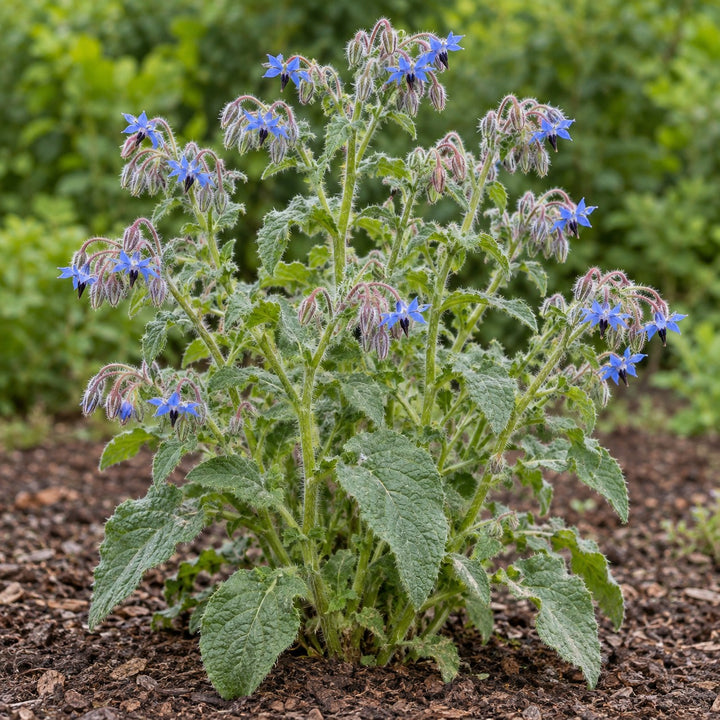
Borage (Borago officinalis) is a fast-growing annual herb with nodding, bright blue, star-shaped flowers and wrinkled gray-green leaves covered in bristly hairs. It grows big and a little sprawling in a single season, and from midsummer on, it is hard to find a borage flower without a bee on it.
It is an old kitchen-garden favorite and a natural neighbor for lavender. Both like sun, both get by on little water once established, and the clear blue of borage next to purple lavender is a combination that never looks forced.
Borage at a glance
| Trait | What to expect |
|---|---|
| Botanical name | Borago officinalis |
| Flowers | Bright blue, nodding stars under 1 inch across |
| Foliage | Wrinkled, dull gray-green, bristly |
| Size | 24 to 36 inches tall, 12 to 16 inches wide |
| Bloom | Starts mid-June, peaks mid-July, continues into fall |
| Life cycle | True annual; dies with frost in zones 5 to 6 and readily reseeds |
| Water needs | Low once established |
| Wildlife | Excellent for pollinators; deer resistant |
Where borage fits with lavender
Borage is a filler, not a structure plant. It grows quickly to fill gaps while young lavender plants are still small, and it keeps a steady stream of blue flowers going through summer and into fall, long after the main lavender bloom. Bees that come for the lavender stay for the borage, and the other way around.
Because it gets two to three feet tall and leans as it grows, plant it at the back or ends of a lavender bed rather than right in front, and keep it from flopping onto lavender mounds where it would block sun and airflow. A kitchen garden or herb bed near the lavender is another good home.
Planting and care
- Sun: full sun gives the most flowers.
- Soil: average, well-drained soil is plenty. It does well in dry, sunny places once established.
- Water: regularly while young, then lightly.
- Stems: hollow and brittle. Plant out of strong wind or let neighbors lean in for support.
- Problems: few. Older plants can get powdery mildew, and slugs or leaf miners sometimes mark the leaves.
- Next year: borage drops seed freely. Expect volunteer seedlings in spring, and thin or move them while small.
In the kitchen
Borage flowers and young leaves are edible, with a fresh, cucumber-like flavor. The flowers are the showpiece: float them on lemonade, freeze them into ice cubes, scatter them over salads or press them onto frosted cakes beside a few lavender buds. Pick flowers in the morning and pinch out the hairy back of the bloom by gently pulling the blue star away. Older leaves get very bristly, so use only the young ones. Use only plants grown as a food crop.
Choosing a size
Borage is offered as a 3-inch plug, a 4-inch pot and a 1-gallon pot. Plugs and 4-inch pots grow fast enough to fill in within weeks; the gallon size gives you flowers sooner. See the product page for current sizes and availability.
Frequently asked questions
Does borage come back every year?
It is a true annual and dies with frost, but it reseeds so readily that most gardens have borage again the following spring.
Do the flowers really change color?
Borage flowers are typically bright blue. Buds and fading flowers can show a pinkish tint, which is normal.
Does it smell like lavender?
No. Its scent is light. The cucumber note shows up mostly when you taste it.

































Share how it went in your field