

Product Field NotesLavender Plants
Castilliano Lavender: Deep Purple Butterfly Blooms in Spring
 Save
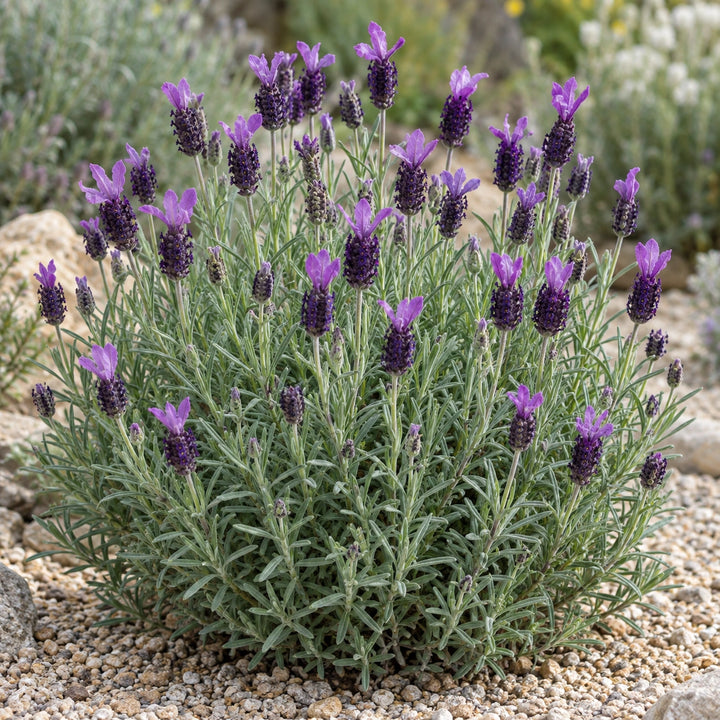
Castilliano lavender is a compact, bushy plant with deep purple flower heads topped by the flared flags that give this group its nickname, butterfly lavender. It flowers early in the season, reblooms heavily and carries a strong, bold, resinous-herbal scent that announces itself from a step away.
Botanically it is Lavandula pedunculata, a close cousin of Spanish lavender. The species name refers to the peduncle, the bare flower stalk, which in this group tends to be long and holds the blooms up clearly above the gray-green foliage.
Castilliano at a glance
| Trait | What to expect |
|---|---|
| Botanical name | Lavandula pedunculata 'Castilliano' |
| Flower color | Deep purple |
| Foliage | Gray-green |
| Habit | Bushy and compact |
| Mature size | About 14 inches tall and 8 inches wide |
| Bloom | Starts early May, peaks late May in warm climates, high rebloom |
| Hardiness | USDA zones 7a to 9b |
| Fragrance | Strong, bold, resinous and herbal |
| Culinary use | Not recommended |
Butterfly lavender versus Spanish lavender
Gardeners often lump L. pedunculata in with Spanish lavender, and the two do look alike: plump heads, colorful flags, early bloom and a camphor-rich scent. The difference that is easiest to spot is the stalk. Butterfly lavender tends to carry its flowers higher on longer bare stems, which gives the plant an airy, fluttering look in a breeze.
Cold tolerance in this species depends a good deal on the plant's origin and the growing conditions, so the zone rating is the best guide. Castilliano is rated for zones 7a to 9b.
Where it fits
At about 14 inches tall and 8 inches wide, Castilliano is a small, tidy plant. It is ideal for:
- Patio pots and window boxes in full sun
- Mixed containers with rosemary, thyme or silver trailing plants
- Rock gardens and gravel beds in warmer zones
- Early-season color before English lavenders open
It is a great pollinator plant and deer tend to leave it alone.
Planting and care
Use a fast-draining, gritty mix in a container with drainage holes, or a raised, gravelly bed in a warm zone. Full sun is essential. Water deeply, then let the top of the soil dry before watering again. It does not need a winter chill to bloom.
- Deadhead: cut faded heads back to the foliage to keep the rebloom coming.
- Shape: trim lightly after a big flush. Avoid bare wood.
- Winter in cold zones: move pots to a cool, bright, frost-free spot before hard freezes and keep them on the dry side.
- Spring: return pots outdoors gradually after frost. The Frost Date Estimator helps with timing.
Flowers and uses
Castilliano is rated good for both fresh-cut and dried flowers, a little better at drying than many Spanish types, and its listed best use is fragrance. Dried heads hold their shape and make a charming addition to potpourri bowls or small wreaths. Culinary use is not recommended.
Formats offered
Castilliano is listed as a 3-inch plug, a 4-inch pot or a 1-gallon pot. See the product page for current sizes and availability, and use Notify Me if it is not ready yet.
Frequently asked questions
Is Castilliano the same as Castilliano 2.0?
No. Castilliano is listed as Lavandula pedunculata with deep purple flowers, while the Castilliano 2.0 series is listed as Lavandula stoechas in Lilac, Rose and White.
Can I dry the flowers?
Yes. It is rated good for dried flowers. Cut when the heads are fully colored and hang them in a dark, airy spot.
Does it need winter chill to bloom?
No. It blooms without a cold period, which suits container growing.

































Share how it went in your field