

Product Field NotesCompanion Plants
Catnip: The True Nepeta for Cats, Bees and the Tea Garden
 Save
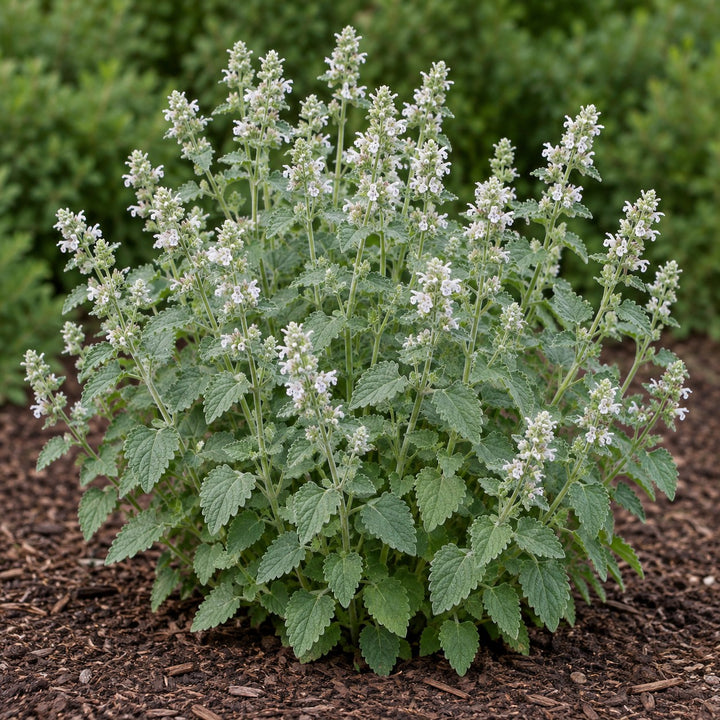
Catnip is the true one, Nepeta cataria, the plant that turns many calm house cats into small, rolling lunatics. It is a tough perennial with downy, gray-green, coarsely toothed leaves and dense spikes of small white flowers dotted with pale purple. Bees love it nearly as much as cats do.
It is also a practical lavender companion. Like lavender, it wants sun, drainage and very little water, and it belongs in an herb or tea garden as easily as in a pollinator bed.
Catnip at a glance
| Trait | What to expect |
|---|---|
| Botanical name | Nepeta cataria |
| Flowers | Small white flowers with pale purple spots in dense spikes |
| Foliage | Downy, gray-green, toothed and aromatic with a musky mint scent |
| Size | 24 to 36 inches tall and wide |
| Bloom | Starts mid-June, peaks mid-July, repeats after shearing |
| Hardiness | USDA zones 3a to 9b |
| Water | Low once established |
| Wildlife | Great for pollinators; deer resistant; very attractive to many cats |
Growing catnip with lavender
Catnip and lavender are both members of the mint family, and they like the same conditions: sun, lean soil that drains well and a gardener who does not overwater. Catnip's soft, gray-green foliage blends with lavender's silver, and its white flower spikes cool down a bed full of purple.
It is looser and more upright than ornamental catmints, so give it room at the back or ends of an herb bed rather than crowding it into a tight lavender row. Fair warning: if your neighborhood cats find it, they may flatten a plant or two. The Companion Plant Planner can help you choose a spot.
Planting and care
- Site: full sun in most of Michigan; afternoon shade helps where heat and humidity run high.
- Soil: well-drained and not too rich.
- Water: low needs once established. Give it airflow as well as drainage.
- Shearing: cut back after the first flowering to encourage repeat bloom.
- Reseeding: catnip self-sows readily. Deadhead before the seeds ripen if you want it to stay put.
- Problems: resistant to most insects and diseases. Powdery mildew can show up in dry summers.
- Winter: fully hardy here. It dies back and resprouts from the crown in spring.
Harvesting the leaves
Catnip leaves and flowers are edible and mostly used in herbal teas. Scent and flavor peak when the plant is in full bloom, so harvest on a dry morning then. Hang small bundles upside down in a shaded, airy place, then strip and store the dried leaves in an airtight jar. Many cat owners dry a batch for toys, too. The dried stems also hold up well in herbal bundles.
Choosing a size
Catnip is offered as a 3-inch plug, a 4-inch pot and a 1-gallon pot. Plugs are an economical way to start an herb bed; the 1-gallon pot gives you a fuller plant right away. See the product page for current sizes and availability.
Frequently asked questions
Is catnip the same as catmint?
Both are Nepeta, but catnip is Nepeta cataria, with white flowers and the strongest pull on cats. Ornamental catmints are grown mostly for their blue flowers.
Will it come back every year?
Yes. It is a hardy perennial that returns each spring and also reseeds.
Do all cats react to it?
Many cats are strongly attracted to it, but not all. Some ignore it completely.

































Share how it went in your field