

Product Field NotesCompanion Plants
Curtain Call Pink Anemone: Bright Fall Color in a Compact Clump
 Save
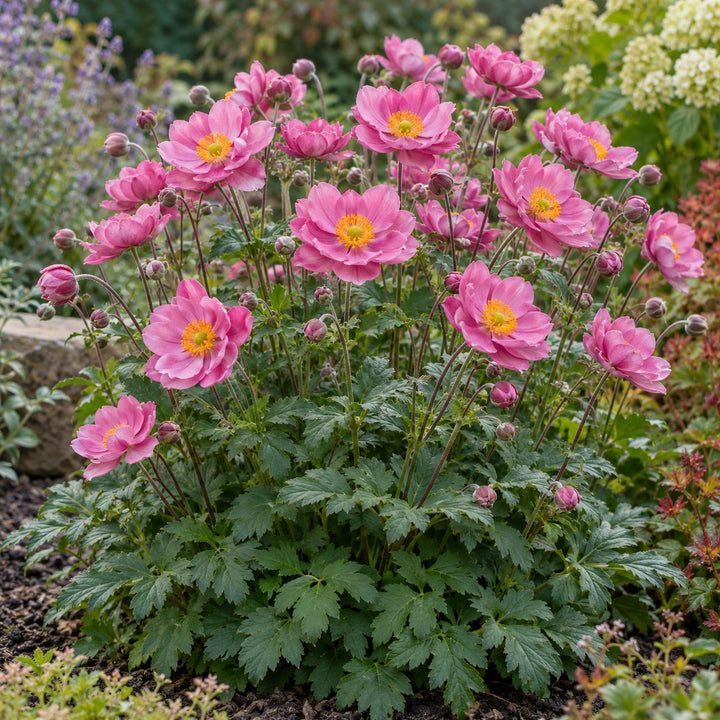
Just when the garden starts looking tired, Curtain Call Pink Japanese anemone opens bright rose pink cups with a double row of petals and a golden ring of stamens. It blooms from late August into early fall on a compact plant only 14 to 18 inches tall, which makes it unusually easy to fit into pots and front borders.
Curtain Call Pink at a glance
| Trait | What to expect |
|---|---|
| Botanical name | Anemone 'Curtain Call Pink' |
| Flowers | Semi-double, bright rose pink, 2 to 2.5 inches across |
| Foliage | Medium green, deeply lobed and three-parted |
| Size | 14 to 18 inches tall, 16 to 18 inches wide |
| Bloom | Late August through September |
| Hardiness | USDA zones 4 to 8 |
| Light | Full sun to part shade |
| Wildlife | Good for pollinators; deer and rabbits avoid it |
Taking the baton from lavender
A lavender garden peaks in early summer. Plan a few late bloomers nearby and the property stays colorful into fall. Curtain Call Pink is a strong choice for that job, but it should not go in the lavender bed itself: it wants richer, steadily moist soil and appreciates afternoon shade, while lavender wants lean, dry ground in full sun.
The easy answer is a container. One plant on its own makes a tidy pot of pink in September, and it mixes well with grasses and sedum in larger planters. In the ground, use it along a partly shaded border or a woodland edge you can see from the lavender beds. Map it out in the Companion Plant Planner.
Getting it established
- Plant in spring. Spring planting gives the roots a full season to settle before winter.
- Feed the soil, not the plant. Work in compost for a fertile, humus-rich bed that still drains well.
- Keep it evenly moist. Cool roots and steady moisture keep leaves from scorching.
- Give it a year. Japanese anemones can sit still their first season, then begin spreading slowly by rhizomes.
- Winter: mulch the first winter, leave foliage standing until spring, and avoid soggy sites, which rot the crowns.
In containers
Use a pot with drainage holes and a rich potting mix, and water whenever the top inch dries. Container plants dry out faster than garden plants, especially in sun. In Michigan, moving pots to a sheltered spot or planting them out in fall helps the roots through winter.
It is offered as a full 72-cell plug tray, a practical size for growers and anyone filling many containers. See the product page for current availability.
Frequently asked questions
Does it make a good cut flower?
It is fair for cutting and poor for drying. Most people enjoy it in the garden, where it keeps flowering for weeks.
Should I wear gloves?
Yes. All parts are toxic if eaten and the sap can irritate skin, so gloves are wise when you divide or trim it.
Why did it barely grow the first year?
That is normal. Japanese anemones often take a season to settle before filling out.

































Share how it went in your field