

Product Field NotesCompanion Plants
Dark Chocolate False Indigo: Near-Black Spires Behind Lavender
 Save
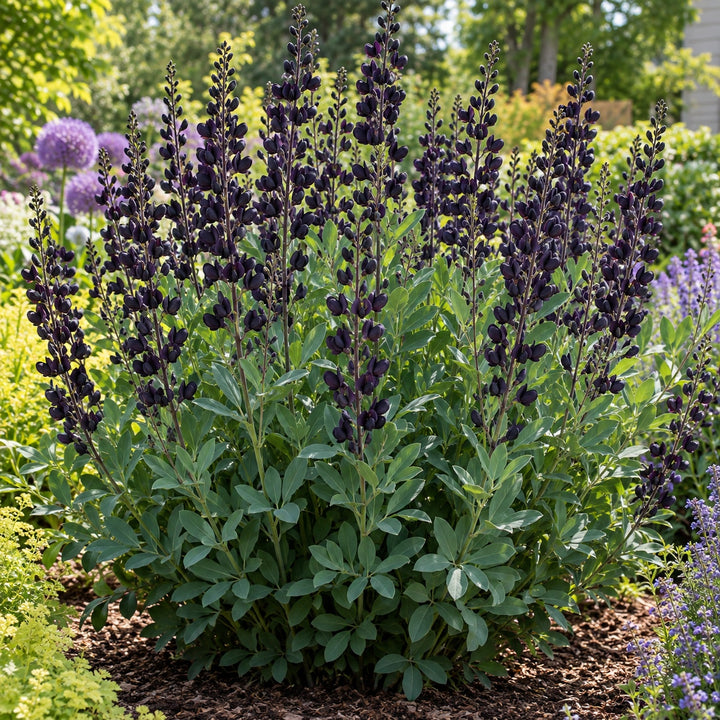
Dark Chocolate false indigo is a Baptisia with pea-shaped flowers so dark they read as nearly black charcoal purple, carried on dark stems in spikes up to about 27 inches long. The spikes stand well clear of a full, bushy mound of blue-green leaves that grows 3 to 3½ feet tall, giving the garden shrub-like structure from a perennial.
Dark Chocolate at a glance
| Trait | What to expect |
|---|---|
| Botanical name | Baptisia 'Dark Chocolate' |
| Flowers | Nearly black charcoal purple, on spikes 20 to 27 inches long |
| Foliage | Blue-green, three-parted leaves |
| Size | 36 to 42 inches tall, about 36 inches wide |
| Bloom | Starts late May, peaks early June |
| Hardiness | USDA zones 4 to 9 |
| Light | Full sun to part shade |
| Wildlife | Great for pollinators; deer resistant |
A dark backdrop for lighter purple
Lavender is a low, rounded plant, and a bed of it can look flat from a distance. Dark Chocolate adds height and depth. Its nearly black spires make lavender's lighter purple pop, and after bloom, the blue-green mound acts like a low hedge behind the lavender rows. Plant it at the back of a bed or as a specimen at the end of a row, at least a few feet from the nearest lavender so the bigger plant does not shade it.
It blooms in late May and early June, ahead of most lavender, so it opens the season, then hands the color over. Because both like lean, well-drained soil and little fuss, they live happily as neighbors. Lay out the spacing in the Companion Plant Planner.
Planting a bare root Baptisia
- Choose a permanent spot. A deep taproot makes established plants drought tolerant and very long lived, but also hard to move.
- Plant at the right depth. Set the crown just below the soil surface with the roots pointing down, then water well.
- Be patient. Expect a couple of seasons of root building before it fills out into its full, bushy form.
- Skip the fertilizer. Like other legumes, it does fine in lean soil.
Soggy winter soil is the main cause of loss, so plant where water drains away. It is fully hardy in Michigan with no winter protection.
Cutting and seed pods
The long spikes are good for cutting and fair for drying, and they make a dramatic tall stem in an arrangement with dried lavender. After bloom, dark seed pods form; leave them standing for winter interest or cut the stems down in late fall. It is offered as a bare root plant. See the product page for current availability.
Frequently asked questions
Is false indigo safe to eat?
No. It contains alkaloids and is considered mildly toxic if eaten. It is grown as an ornamental only.
How is it different from older chocolate Baptisias?
Dark Chocolate has darker flower color and a fuller, bushier habit than the older 'Dutch Chocolate'.
Why did it barely grow the first year?
Baptisia spends its early seasons building a deep root system. Top growth catches up after that.

































Share how it went in your field