

Use & Care NotesLavender Plants
DOWPHSCNT Lavender: A Short, Compact Lavandin with Wide Spikes
 Save
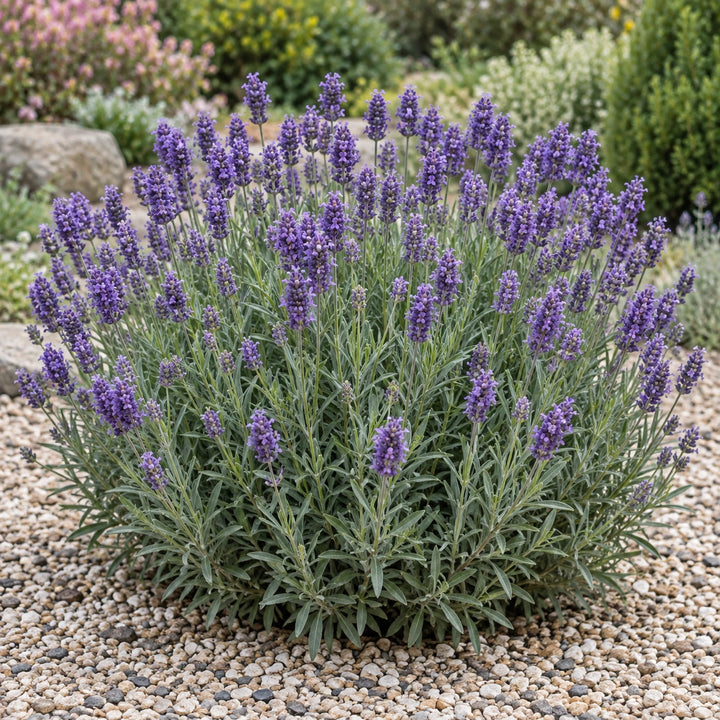
DOWPHSCNT lavender is a lavandin that has been shrunk to fit. Most lavandins grow into big, sprawling mounds; this one stays short and compact, about 2 feet tall and 32 inches wide, with violet flowers gathered into short, wide, uniform spikes. The flowers smell strongly of lavender, and the gray-green foliage has a camphor edge when brushed.
It is a Lavandula × intermedia that arose as an induced mutation of the well-known lavandin 'Abrialii', and it is listed under its cultivar code name.
DOWPHSCNT at a glance
| Trait | What to expect |
|---|---|
| Botanical name | Lavandula × intermedia 'DOWPHSCNT' |
| Origin | Induced mutation of 'Abrialii' |
| Flower color | Violet, in short, wide, uniform spikes |
| Foliage | Gray-green, camphor-scented |
| Habit | Short and compact |
| Mature size | About 24 inches tall and 32 inches wide |
| Stems and spikes | Stems about 10 to 12 inches; spikes about 1.5 to 4.5 inches |
| Bloom | Starts mid-June, peaks mid-July, single flush, no rebloom |
| Hardiness | USDA zones 7b to 8a |
The appeal of a compact lavandin
Lavandins are loved for their strong scent and heavy flowering, but their size can be a problem in small gardens. DOWPHSCNT keeps the lavandin character, including bold fragrance and a showy July flush, in a shorter, more manageable plant. Its short, wide spikes give it a chunkier, more sculptural look than the long wands of a typical lavandin.
Hardiness: plan for protection
Its zone rating, 7b to 8a, is narrower and milder than most lavandins, which are commonly hardy to zone 5. In Michigan that means:
- Containers are the safest choice. Use a large pot with drainage holes and a gritty mix, and move it to an unheated garage, porch or cold frame for the coldest weeks, where it stays cool but out of hard freezes.
- It still needs a winter chill. Lavandins need cold to bloom well, so overwintering in a warm house is not ideal. Cool and dry is the goal.
- In the ground, only the warmest, best-drained microclimate, such as a raised bed against a south wall, gives it a fighting chance.
The USDA Zone Finder will tell you where you stand.
Summer care
- Sun: full sun, all day if possible.
- Water: let the soil dry between waterings. Containers in July heat need more frequent checks.
- Feeding: very little.
- After bloom: cut spent stems back and shape the mound, staying in leafy growth. There is no rebloom, so this is the one cleanup of the year.
- Airflow: do not crowd it. Lavandins prefer low to moderate humidity.
Flowers and uses
DOWPHSCNT is rated good for both fresh and dried flowers, and its listed best use is fragrance. Harvest when most buds are colored and a few flowers are open, then hang small bundles in a dark, airy place. The short, wide spikes look charming in small jars and dried arrangements. Culinary use is not recommended for this cultivar.
It is a great pollinator plant, and deer tend to leave it alone.
Formats offered
DOWPHSCNT is listed as a 3-inch plug, a 4-inch pot or a 1-gallon pot. For container growing, a gallon plant gets you to a showy size sooner. See the product page for current sizes and availability, and use Notify Me if it is not ready yet.
Frequently asked questions
Why does it have a code name?
Some lavenders are registered under code-style cultivar names. DOWPHSCNT is the name this one is listed under.
Is it related to Abrialii?
Yes. It is documented as an induced mutation of the lavandin 'Abrialii'.
Will it rebloom?
No. It has one main flush in midsummer.
















Share how it went in your field