

Product Field NotesCompanion Plants
Dragon Slayer Yucca: A Powder-Blue Ball Beside Lavender
 Save
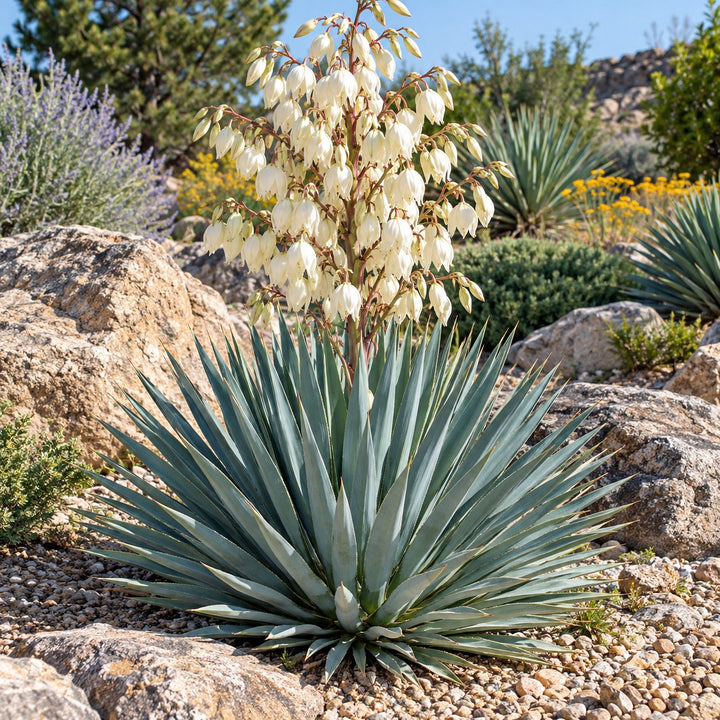
Dragon Slayer yucca forms a near-perfect round rosette of stiff, sword-shaped leaves in a chalky powder blue. It keeps its shape and color all year, about 24 inches tall and 30 to 36 inches wide. Once plants mature, branched stalks around 4 feet tall rise from the center in early summer, lined with nodding, creamy white bells with a light, sweet scent that is most noticeable in the evening.
Dragon Slayer at a glance
| Trait | What to expect |
|---|---|
| Botanical name | Yucca 'Dragon Slayer' |
| Foliage | Powdery blue, stiff and evergreen |
| Flowers | Creamy white bells on branched stalks about 4 feet tall |
| Size | Rosette about 24 inches tall, 30 to 36 inches wide |
| Bloom | Starts late June, peaks early July |
| Hardiness | USDA zones 5 to 10 |
| Light | Full sun for best form; tolerates part sun |
| Deer | Resistant; rabbits leave it alone |
Why it pairs so well with lavender
Dragon Slayer wants exactly what lavender wants: full sun, dry, lean soil and good drainage. Its powder-blue leaves sit naturally beside lavender's gray-green foliage, and the bold, spiky ball shape contrasts with lavender's soft mounds. In winter, when lavender is a muted gray, the evergreen blue rosette keeps the bed looking planted.
Use one as a focal point at the end of a lavender row, at a path corner or in a gravel garden with lavender drifts around it. Its creamy flower stalks open in late June and early July, right with the lavender, and look like candelabras rising above the purple. Lay out the bed in the Companion Plant Planner.
Care
- Soil: any well-drained soil, even poor. Avoid low spots where water sits in winter.
- Water: extremely drought tolerant once established.
- After bloom: cut the flower stalk at the base. The flowering rosette slowly declines and is replaced by offsets, so the clump spreads into a loose colony over time.
- Spring: remove only damaged or old lower leaves.
- Winter: evergreen in Michigan in well-drained soil.
The leaf tips are sharp, so keep it a step back from paths where people brush by, and wear gloves when tidying.
Containers and formats
Its tidy rosette suits large patio containers with a gritty mix. In the ground it fits rock gardens, dry slopes, xeriscapes and coastal plantings. It is offered as a full 72-cell plug tray, a practical size for growers and large dry-garden projects. See the product page for current availability.
Frequently asked questions
When will it flower?
Young plants focus on leaves. Flower stalks come once the rosette matures.
Does it stay blue all year?
Yes. It holds its powdery blue color and shape through every season.
Will it spread?
Slowly. Offsets form around the base, especially after a rosette flowers, creating a loose colony.

































Share how it went in your field