

Product Field NotesCompanion Plants
Drummond's Pink Creeping Phlox: A Spring Carpet Along Lavender
 Save
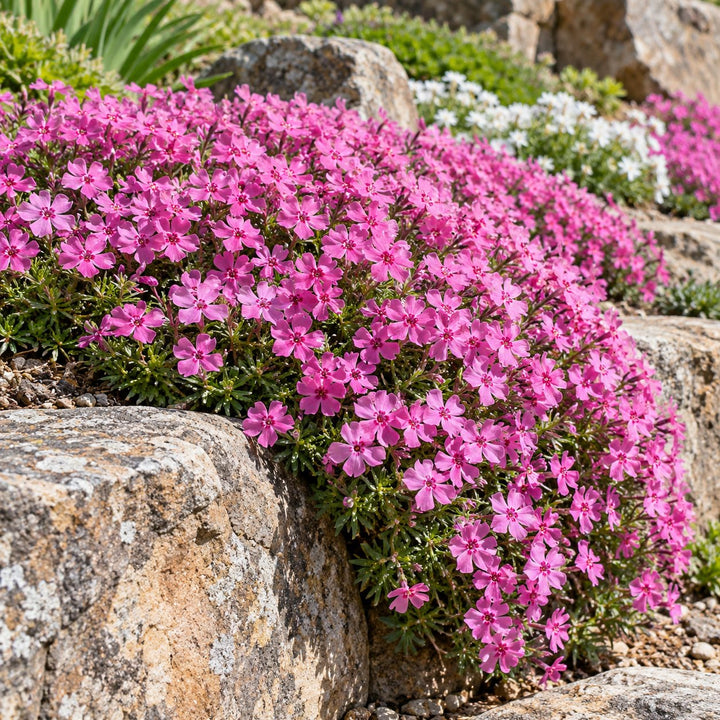
Drummond's Pink creeping phlox is a long-grown classic for good reason. In late April and early May, its rich rose-pink flowers, each about three-quarters of an inch across with notched tips and a darker rose eye, pack so tightly that they hide the leaves completely. The rest of the year it is a low, dense mat of tiny, needle-like evergreen leaves just 4 to 6 inches tall.
Drummond's Pink at a glance
| Trait | What to expect |
|---|---|
| Botanical name | Phlox subulata 'Drummond's Pink' |
| Flowers | Rich rose pink with a darker eye, faint sweet scent up close |
| Foliage | Deep green, needle-like, evergreen |
| Size | 4 to 6 inches tall, 18 to 20 inches wide |
| Bloom | Starts late April, peaks early May |
| Hardiness | USDA zones 2 to 9 |
| Light | Full sun |
| Deer | Moderately resistant |
Spring color before lavender wakes up
In April and May, lavender is still a gray, sleepy mound. A ribbon of Drummond's Pink along the front of the bed changes that, turning the edge into a solid band of rose pink weeks before the lavender blooms. Once the phlox finishes, its evergreen mat stays neat and green, a clean edge that lets the purple lavender take the spotlight in June and July.
Both plants like sun and well-drained soil and dislike wet feet, so they share a bed easily. Keep the phlox a few inches in front of the lavender crowns so its mat does not trap moisture around their bases. Plan the edge in the Companion Plant Planner.
Care
- Soil: average and well drained. It tolerates dry spells and dislikes soggy ground.
- Water: occasional deep watering in very hot, dry spells keeps the mat from browning.
- After bloom: shear back by about a third to keep the mat dense and tidy.
- Watering method: avoid overhead watering; dense, wet mats can rot in the center.
- Winter: hardy in Michigan. The foliage stays green or bronzes. Do not pile leaves or mulch on the mat, and trim out winter-browned patches in spring.
Slopes, walls and formats
Its trailing stems make it ideal for sunny slopes, rock walls and the edges of raised lavender beds, where it can spill over the side. Bees and butterflies visit the spring flowers, an early food source before the lavender opens. It is offered as a 72-cell plug tray for growers and large edgings, and as a bare root plant. See each product page for current availability.
Frequently asked questions
How far apart should I plant it?
About 12 to 18 inches apart will knit into a solid mat within a few seasons, since each plant spreads 18 to 20 inches.
Does it bloom again in summer?
No. It has one big spring show. The evergreen mat carries the rest of the year.
Can it grow in a container?
Yes. It looks lovely spilling over the edge of a sunny pot with good drainage.

































Share how it went in your field