

Use & Care NotesCompanion Plants
Elegans Hosta: The Classic Puckered Blue Giant for Woodland Beds
 Save
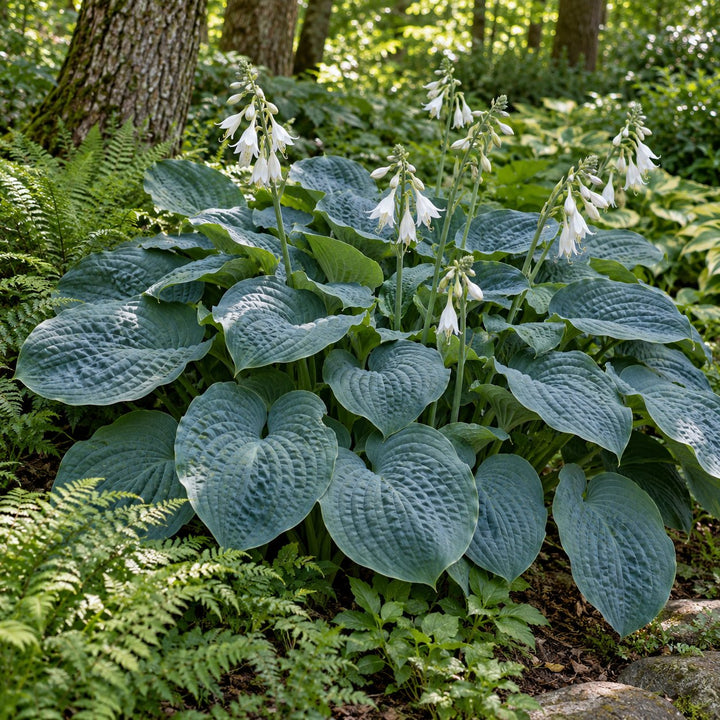
Elegans hosta is one of the old classics among big blue hostas, and it has stayed popular for good reason. Its rounded, powdery blue-gray leaves grow up to about 10 inches long and 9 inches wide, getting thicker and more deeply puckered between the veins as the plant matures. In early to mid-July, clusters of white bells open on 34-inch scapes just above the foliage. It holds the Royal Horticultural Society's Award of Garden Merit.
Elegans at a glance
| Trait | What to expect |
|---|---|
| Botanical name | Hosta sieboldiana 'Elegans' |
| Foliage | Powdery blue-gray, thick, deeply puckered, up to about 10 by 9 inches |
| Flowers | White bells on 34-inch scapes |
| Size | 24 to 36 inches tall, 40 to 48 inches wide |
| Bloom | Early to mid-July |
| Hardiness | USDA zones 3 to 9 |
| Light | Part sun to full shade; afternoon shade holds the blue |
| Deer | Susceptible |
The backdrop of the shade garden
In a garden plan where lavender owns the sun, Elegans is a natural choice to own the shade. Its blue-gray color is a close relative of lavender's silvery foliage, so the shaded beds and sunny beds share a cool palette even though they never share soil. Use it as a backdrop at the rear of a woodland bed or as a single specimen where its texture can be admired.
It grows slowly to its full size, so start it where it can stay. Pair it with ferns for fine texture, astilbe for summer plumes and smaller gold hostas for contrast. Plan the shade and sun beds together in the Companion Plant Planner.
Keeping it blue and healthy
- Shade: the blue comes from a waxy coating that melts away in heat and strong sun. Afternoon shade keeps it blue longest.
- Water: deep watering in dry spells, especially the first summer.
- Slugs: the heavy leaves resist slug damage better than most hostas.
- Airflow: long wet spells can bring anthracnose spots; give the clump room.
- After bloom: cut spent scapes.
- Fall and winter: cut leaves down after hard frost, and do not pile heavy, wet mulch over the crown. Fully hardy in Michigan.
Tray options
Elegans is offered as a 72-cell plug tray and a 20-cell plug tray. The 72-cell tray suits growers and woodland-scale plantings; the 20-cell tray offers fewer, deeper plugs to grow on. See each product page for current availability, or visit the Wholesale Hub.
Frequently asked questions
Is it safe for pets?
Hosta foliage is listed as toxic to dogs and cats, so plant it where pets are not tempted to chew.
Why are my leaves turning green in August?
Heat and sun wear away the blue wax. More afternoon shade helps the color last.
How long until the leaves pucker?
Puckering deepens as the plant matures over several seasons, so young plants look smoother.



Share how it went in your field