

Product Field NotesCompanion Plants
Fusion of Fire Mukdenia: Big Maple Leaves That Blaze in Fall
 Save
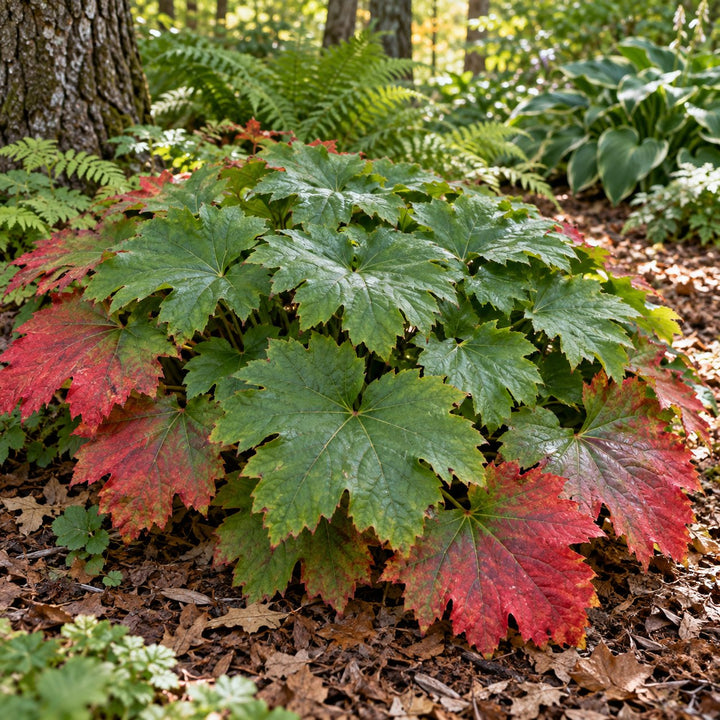
Fusion of Fire mukdenia is a shade perennial grown mostly for its leaves, and they are big ones: rounded, lobed like a maple, deeply notched and often more than 12 inches across. They emerge a slightly glossy medium green and turn bright scarlet red in fall. In early spring, loose sprays of starry blush-pink flowers rise on reddish stems just above the new foliage.
It wants shade and steady moisture, which is the opposite of what lavender wants. On a property with sunny lavender beds, it is a plant for the woodland edge or the shaded corner by the house.
Fusion of Fire at a glance
| Trait | What to expect |
|---|---|
| Botanical name | × Oredenia 'Fusion of Fire' |
| Foliage | Medium green, maple-like, often over 12 inches wide, scarlet red in fall |
| Flowers | Blush pink to white starry sprays on reddish stems |
| Size | 12 to 14 inches tall, 18 to 24 inches wide |
| Bloom | Early April, peaking late April, for about three weeks |
| Hardiness | USDA zones 5 to 8 |
| Light | Part shade to full shade, filtered sun ideal |
| Deer | Moderately resistant |
Where it fits in a lavender garden plan
Lavender asks for hot sun and dry, lean soil. Fusion of Fire asks for cool shade and moisture. Rather than force them together, give each its own part of the yard. Fusion of Fire is at its best where you can see the leaves up close: edging a shaded walk, as a specimen in a woodland bed, or in a large patio container on the shady side of the house. Its bold foliage contrasts well with fine-textured ferns and the broad, smooth leaves of hostas. Plan both the sunny and shady areas in the Companion Plant Planner.
A plant with three seasons
- Spring: pink flower sprays appear with or just before the new leaves. Trim spent flower stems afterward.
- Summer: a low, broad mound of overlapping lobed leaves.
- Fall: the foliage turns bright scarlet, sometimes with yellow tones, one of the best fall colors in a shade bed.
It flowers more heavily and grows more vigorously than a typical mukdenia, though it still takes a few seasons to reach full size.
Care notes
Keep the soil evenly moist and shield the plant from hot afternoon sun, which scorches the leaves. Good drainage matters even in shade. Slugs may chew the foliage in damp spots; otherwise pests and diseases are few. Because it blooms so early, a late spring frost can nip the flowers, but the leaves carry on. A light mulch helps young plants through their first winter, and you can cut back tattered foliage in late fall or early spring, before the flowers appear.
About the 20-cell tray
Fusion of Fire is offered as a 20-cell plug tray, with larger, deeper cells that give each young plant a stronger start. See the product page for current availability.
Frequently asked questions
Can it grow in the sun next to lavender?
No. Hot sun and dry soil scorch the leaves. It belongs in shade with steady moisture.
What is an Oredenia?
It is a hybrid between two related shade plants, Oresitrophe and Mukdenia, which is why it is often sold as a mukdenia.

































Share how it went in your field