

Product Field NotesLavender Plants
Huckleberry Lavender: Our Own Seed-Grown Deep Purple Selection
 Save
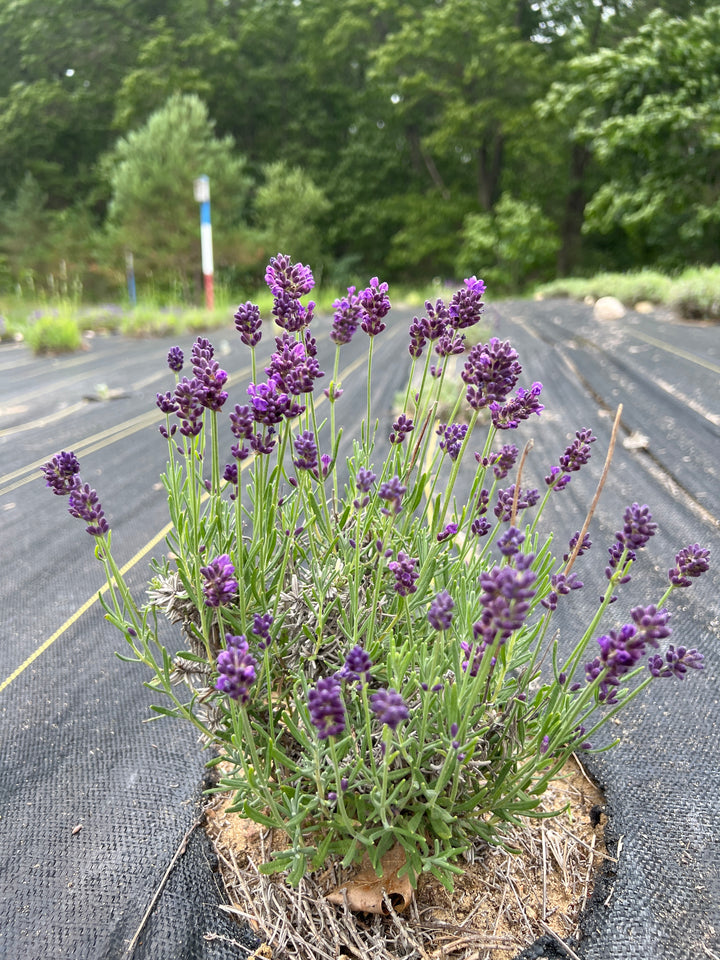
Huckleberry lavender is a Great Lakes Lavender Farm selection of English lavender. It started from seed sold as 'Deep Purple', but plants grown from seed are genetically distinct from their parents, so we keep Huckleberry as its own plant rather than calling it the original cultivar. What you get is a compact, mounding, bushy English lavender with deep purple flowers over gray-green foliage.
It also shares its name with our border collie, who likes to supervise whenever anyone is planting. The plant is considerably calmer.
Huckleberry at a glance
| Trait | What to expect |
|---|---|
| Botanical name | Lavandula angustifolia, selection Huckleberry |
| Identity | Seed-grown farm selection |
| Flower color | Deep purple |
| Foliage | Gray-green |
| Habit | Compact, mounding and bushy |
| Bloom | Starts mid-June, peaks late June, single flush |
| Hardiness | USDA zones 5a to 9b |
| Fragrance | Moderate; floral with sweet, herbaceous notes |
What a seed-grown selection means
Named lavender cultivars are usually grown from cuttings, so every plant is a clone. Lavender grown from seed varies a bit from plant to plant, the way siblings do. Rather than sell those seedlings under a name that is not quite accurate, we grow them as Huckleberry, a selection with its own identity. Expect the deep purple color and compact, mounding habit, with the small natural variation that comes with seed-grown plants.
Where it fits
Deep purple English lavender is the classic garden look. Huckleberry works well as a low hedge, an edging along a walk, a repeating accent through a sunny border or a mass planting where slight variation reads as natural rather than uniform. It rates great for pollinators and is deer resistant. Mature size can vary; check the listing for the current size information.
Planting and care
- Sun: full sun.
- Soil: lean and well drained; raise the bed on clay.
- Spacing: about 18 to 24 inches, adjusted to how wide your plants grow.
- Water: deeply during the first season, then sparingly.
- Winter: it needs a winter chill to bloom well. Keep the crown dry.
Bloom, harvest and pruning
Huckleberry blooms in one main flush, peaking in late June, and does not rebloom. That makes timing simple: cut stems for drying when buds are fully colored and a few flowers have opened, then hang them in a dark, airy place. It rates good for fresh and dried flowers. After harvest, shear the mound lightly in green growth to keep it compact, and stop pruning by late summer. The Pruning Calendar has the timing.
It is not recommended for culinary use. For baking, choose an English lavender rated for cooking.
Plant sizes
Offered as 3-inch plugs, 4-inch pots and 1-gallon pots. See the product page for current sizes and availability.
Frequently asked questions
Is Huckleberry the same as Deep Purple lavender?
No. It came from seed sold as 'Deep Purple', but seed-grown plants are genetically distinct, so we grow and sell it as its own selection.
Will every plant look identical?
Close, but not cloned. Seed-grown lavender varies slightly in size and shade.
Does it rebloom?
No. It puts on one main show from mid to late June.

































Share how it went in your field