

Product Field NotesLavender Plants
IBPRU41016 Lavender: Ruffled Purple Bracts Over Violet-Blue Heads
 Save
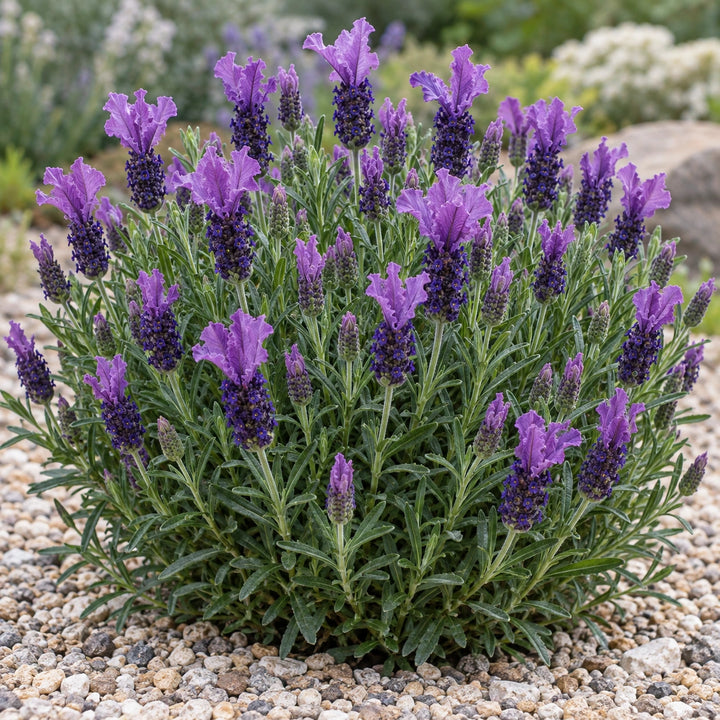
IBPRU41016 lavender is all about the bracts. Its dark violet-blue flower heads are topped with very large, ruffled purple sterile bracts that look more like frilly ribbons than the usual straight flags. The plant itself stays compact, bushy and branching, about 7 inches tall and 9 inches wide, over dark green foliage.
It is Lavandula pedunculata, a cross between two other butterfly lavenders with ruffled reputations. It is rated for USDA zones 7a to 10b, a little more cold-tolerant than many in its group, though still not reliably hardy in a typical Michigan winter.
IBPRU41016 at a glance
| Trait | What to expect |
|---|---|
| Botanical name | Lavandula pedunculata 'IBPRU41016' |
| Flowers | Dark violet-blue heads under very large ruffled purple bracts |
| Foliage | Dark green, compact and branching |
| Size | About 7 inches tall and 9 inches wide |
| Stems and heads | Stems about 1.5 inches; flower heads about 1.75 inches long |
| Bloom | Starts early May, peaks late May, with high rebloom |
| Hardiness | USDA zones 7a to 10b |
| Fragrance | Moderate; bold resinous-herbal with camphor and eucalyptus-like notes |
The ruffles are the reason
Plenty of Spanish lavenders have flags. Few have flags this big and this frilled. On IBPRU41016 the bracts are large compared to the short flower head, so from a few feet away the plant looks dotted with purple bows. It is a showpiece for a container right by the door, where people actually see it up close.
Set it beside a white or light pink Spanish lavender and the dark violet-blue heads look almost navy. Against gray stone or weathered wood, the purple ruffles carry the color.
Planting and care
- Sun: full sun keeps the plant dense and the bracts well colored.
- Drainage: gritty mix in pots; raised or sloped ground in beds. Wet roots are the main killer.
- Water: regularly while new, then only when the top inch or two is dry.
- Deadheading: snip faded heads back to the foliage to encourage the next round.
- Fertilizer: little to none.
Not sure which side of zone 7a you are on? Check the USDA Zone Finder.
Winter: zone 7a and the rest of us
Gardeners in zone 7a and warmer can try it in the ground with excellent drainage, because winter wet does more damage than cold. Most of Michigan is colder than 7a, so here it makes more sense as a container plant brought into a cool, bright room before a hard freeze, or as a long-blooming annual. Keep overwintering plants on the dry side.
Uses and formats
IBPRU41016 rates good for fresh and dried flowers and great for pollinators. Its short stems suit tiny bouquets, gift-tag sprigs and dried heads in sachets. It is grown as an ornamental and is not recommended for cooking.
It is offered as a 3-inch plug, 4-inch pot or 1-gallon pot. See the product page for current sizes and availability, or sign up on the Availability Alerts page if it is not available right now.
Frequently asked questions
What is the difference between pedunculata and stoechas?
Both belong to the same group of Spanish or butterfly lavenders with flags on top. The botanical groups page explains how they are sorted.
Will it survive winter in zone 7?
It is rated to zone 7a. In that zone, good drainage and a dry winter site give it the best chance.
How long does it bloom?
It starts in early May where it grows outdoors, peaks in late May and reblooms heavily when spent heads are removed.

































Share how it went in your field