

Use & Care NotesLavender Plants
Javelin Forte Deep Purple: Extra-Large Flags That Shrug Off Humidity
 Save
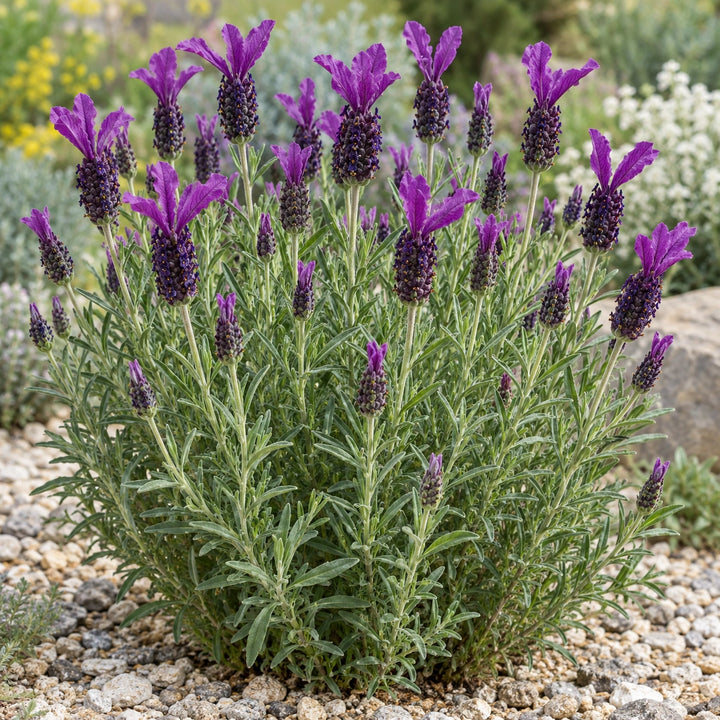
Javelin Forte Deep Purple lavender is a Spanish lavender with deep purple flower heads crowned by extra-large flags. It grows upright and well branched, about 14 to 20 inches tall and 12 to 16 inches wide, over gray-green foliage, and its fragrance is rated strong.
It is Lavandula stoechas from the Javelin series, rated for USDA zones 7a to 9b. The Forte types are documented with exceptional disease tolerance, which is worth a lot in a humid Great Lakes summer, when damp air is often harder on lavender than heat.
Javelin Forte Deep Purple at a glance
| Trait | What to expect |
|---|---|
| Botanical name | Lavandula stoechas Javelin Forte Deep Purple |
| Flower color | Deep purple with extra-large flags |
| Foliage | Gray-green, upright, well branched |
| Size | About 14 to 20 inches tall and 12 to 16 inches wide |
| Bloom | Starts early May, peaks late May, repeats through summer |
| Hardiness | USDA zones 7a to 9b |
| Disease tolerance | Documented as exceptional |
| Fragrance | Strong, resinous-herbal with camphor and eucalyptus-like notes |
The case for a tougher Spanish lavender
Spanish lavenders love sun and hate sitting wet. In a muggy July, with rain one day and steam the next, crowded plants can brown out from the inside. A selection known for disease tolerance gives you more margin for error. It still needs good drainage and airflow, but it is more forgiving when the weather does not cooperate.
The extra-large flags are the visual payoff. Deep purple heads topped with oversized bracts make a pot look full from a distance, and strong branching keeps new flower stems coming.
Where to grow it
- A single plant in a 12- to 14-inch pot by an entry or on a sunny deck.
- Three plants in a long trough or window box.
- The front of a sunny, well-drained border in zone 7a and warmer.
- Mixed containers with white or pink Spanish lavenders for contrast.
Care that keeps it flowering
Water deeply, then let the top inch dry before watering again; water needs are low once established. Clip spent heads back to the foliage every week or two, and give it a light shearing after the late-May peak to reset for summer bloom. Feed sparingly, if at all. Space plants so leaves do not touch, and avoid evening watering that leaves foliage wet overnight.
If leaves start yellowing or browning, the Plant Health Checker can help sort out whether it is water, drainage or something else.
Winter options
Javelin types are less cold-hardy than English lavender. In most of Michigan, enjoy it as an annual or move the pot to a cool, bright room before a hard freeze and keep the soil on the dry side until spring. Gardeners in zone 7a and warmer can leave it in the ground if winter drainage is sharp.
Cutting and plant formats
Its cut flower rating is good, and big flags make cheerful fresh bouquets. Dried, the flags lose some shape, so the dried rating is fair. Growers like it for pick-your-own color where large bundles matter. It is ornamental and not used for cooking.
It is offered as a 3-inch plug, a 4-inch pot or a 1-gallon pot. See the product page for current sizes and availability, or sign up for Availability Alerts.
Frequently asked questions
Does disease tolerance mean it can handle wet soil?
No. It helps with humid weather, but soggy roots still kill lavender. Fast drainage is a must.
How big are the flags?
The Forte types are documented with extra-large flags, noticeably bigger than most Spanish lavenders.
Is it the same as Javelin Fortissimo Purple?
They are close cousins in the same series. Fortissimo Purple is described with very large, long-lasting flags and lavender-violet color. Compare them side by side on the Compare page.
















Share how it went in your field