

Use & Care NotesLavender Plants
Myrleigh Lavender: A Low Spanish Lavender with a Musky Note
 Save
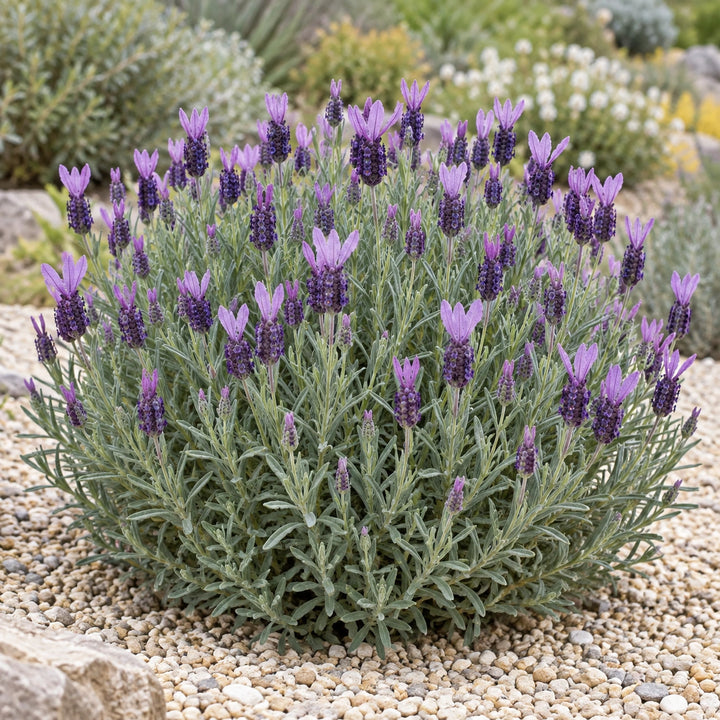
Myrleigh lavender is a Spanish lavender that keeps low. It grows into a bushy, compact plant only about 12 inches tall but nearly 24 inches wide, with gray-green foliage, violet flower heads and light violet bracts on top. Its fragrance is described as musky, which sets it apart from the sharper, resinous scent of many Spanish types.
Think of it as a ground-hugging cousin to the taller stoechas: same cheerful flags, half the height.
Myrleigh at a glance
| Trait | What to expect |
|---|---|
| Botanical name | Lavandula stoechas 'Myrleigh' |
| Flowers | Violet heads with light violet bracts |
| Foliage | Gray-green |
| Size | About 12 inches tall and 24 inches wide |
| Bloom | Starts early May, peaks late May, high rebloom |
| Hardiness | USDA zones 7a to 9b |
| Fragrance | Musky |
| Wildlife | Great for pollinators; deer resistant |
A low, wide shape
Myrleigh's spread is about twice its height, so it reads more like a cushion than a shrub. That makes it a natural for the lip of a wide container, the front of a sunny bed, rock gardens and gaps along a gravel path. In a mixed pot, use it as the low, spilling layer under taller flowers. Its pale violet bracts flutter above the foliage and catch the light.
Planting and drainage
- Sun: full sun all day if you can manage it.
- Soil: gritty and fast-draining. In pots, use a mix with extra grit or perlite.
- Container: wide and shallow works well for this low plant; make sure it has drainage holes.
- Water: regularly while it roots in, then only when the top inch or two is dry.
- Feeding: very light. Lean conditions keep it compact and flowering.
Winter in cold climates
Myrleigh is rated for zones 7a to 9b and, like other Spanish lavenders, is less cold-hardy than English lavender. Cold combined with wet soil is the real danger. In colder zones, grow it in a container and move it to a cool, bright, frost-free place before hard frost, watering only lightly until spring. Or enjoy it as a one-season plant in a window box or border. The USDA Zone Finder helps you decide.
Keeping the flowers coming
Myrleigh has a high rebloom rating, and deadheading is how you unlock it. When the bracts fade and the heads brown, snip each stem back to the foliage. Fresh heads follow. After a big flush, a light trim keeps the cushion tidy; avoid cutting into bare wood.
The flowers are good for small fresh arrangements, though they dry only fairly. It is grown for looks and fragrance and is not recommended for culinary use. Pollinators love it, and deer usually skip it.
Myrleigh is offered as 3-inch plugs, 4-inch pots and 1-gallon pots. See the product page for current sizes and availability.
Frequently asked questions
What does a musky lavender smell like?
Myrleigh's fragrance is described as musky, a warmer, softer note than the sharp camphor scent typical of many Spanish lavenders. Brush the foliage on a warm day to judge for yourself.
Is Myrleigh good for window boxes?
Yes. Its low height and wide spread suit window boxes and shallow planters in full sun.
Can it stay in the ground over winter?
In zones 7a to 9b, yes, with sharp drainage. In colder zones, give potted plants winter shelter or grow it for a single season.
















Share how it went in your field