

Product Field NotesCompanion Plants
Parry's Agave: A Blue-Gray Artichoke for Pots Among the Lavender
 Save
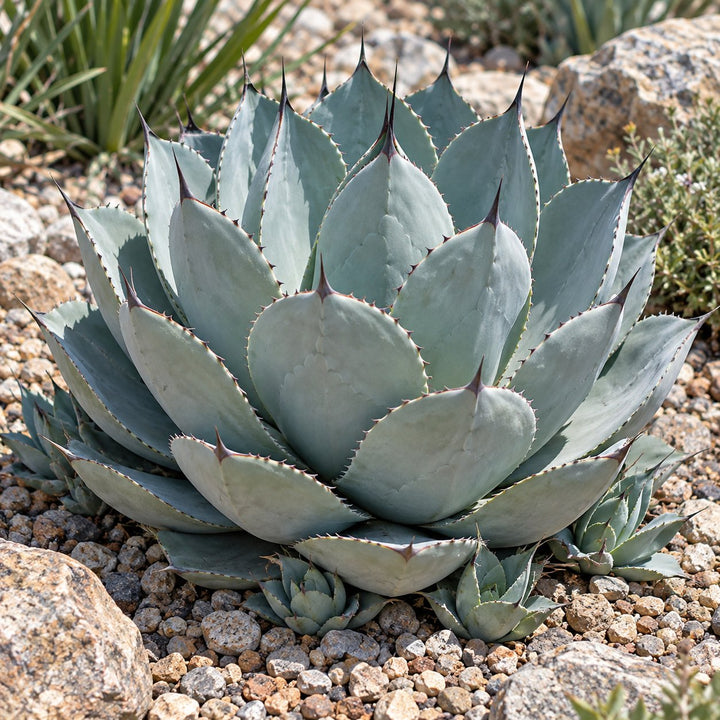
Parry's agave in this compact form, Agave parryi var. truncata, is often called one of the most beautiful agaves. Its short, very wide, spoon-shaped leaves are powdery blue-gray and overlap into a perfectly symmetrical rosette about 18 inches tall and wide. Most people take one look and say artichoke.
Each leaf ends in a dark, sharp terminal spine with small teeth along the edges, so admire it with your eyes, not your shins.
Parry's agave at a glance
| Trait | What to expect |
|---|---|
| Botanical name | Agave parryi var. truncata |
| Foliage | Powdery blue-gray, wide spoon-shaped leaves with dark spines |
| Size | About 18 inches tall and 18 inches wide |
| Habit | Symmetrical, rounded rosette that makes offsets |
| Flowers | Rarely, once after many years |
| Hardiness | USDA zones 6 to 9 |
| Light | Full sun |
| Deer | Resistant |
Why it looks so good with lavender
Agave and lavender share a love of hot sun and sharp drainage, and they look like they belong together. The blue-gray rosette repeats the silvery tone of lavender foliage, while its bold, rounded geometry contrasts with lavender's fine, upright stems. A pot of Parry's agave set on a gravel patio among lavender, or nestled into the gravel at the end of a lavender row, gives the planting a dry-garden, Mediterranean feel.
Lay out pots and beds in the Companion Plant Planner.
Growing it in Michigan
This is among the hardier agaves, but wet winter soil kills it far more often than cold. In the ground, it needs a raised, gravelly bed that stays dry all winter, and even then it is a gamble in most of the state. A container is the easy answer:
- Pot: a heavy container with a drainage hole and a gritty, fast-draining cactus-style mix.
- Summer: full sun. Harden off plants gradually in spring so the leaves do not sunburn.
- Water: sparingly; let the mix dry out completely between waterings.
- Winter: move it to a cold, dry, bright spot or indoors, and keep it nearly dry.
- Pests: watch for mealybugs and scale indoors.
Offsets and the once-in-a-lifetime bloom
Over its life it produces small offset rosettes around the base. Remove them to pot up, replant or share. After many years, a mature rosette sends up a towering flower spike and then dies, but by then the offsets carry on. Check your zone with the USDA Zone Finder.
Handle with care
The spines are sharp and agave sap can irritate skin, so wear gloves when repotting or removing offsets. It is grown as an ornamental, not for eating.
Frequently asked questions
Can I leave it outside all winter?
Only in a raised, gravelly bed that stays dry, and only in zone 6 areas. In a pot, bring it in for winter.
How fast does it grow?
Slowly. It builds into its 18-inch rosette over several years.

































Share how it went in your field