

Product Field NotesCompanion Plants
Praying Hands Hosta: Upright Folded Leaves for a Shady Spot
 Save
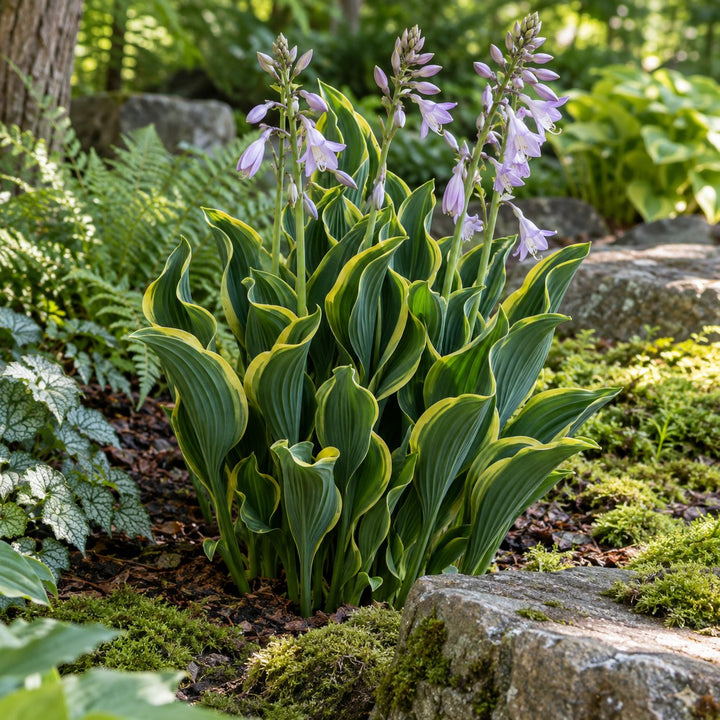
Praying Hands hosta looks like no other hosta. Its narrow, dark green leaves fold tightly lengthwise and stand straight up, like hands pressed together, each with a very thin gold edge and heavy ripples along the blade. Because they are folded, their shiny undersides catch the light. In August, lavender trumpets open in abundance on 18-inch scapes.
It holds the Royal Horticultural Society's Award of Garden Merit. It also wants shade and steady moisture, so its place is the shady side of your property, not the lavender bed.
Praying Hands at a glance
| Trait | What to expect |
|---|---|
| Botanical name | Hosta 'Praying Hands' |
| Foliage | Narrow, upright, tightly folded, dark green with a very thin gold margin |
| Flowers | Lavender trumpets on scapes about 18 inches tall |
| Size | 14 to 18 inches tall, 12 to 16 inches wide |
| Bloom | Starts early August, peaks mid-August |
| Hardiness | USDA zones 3 to 9 |
| Light | Part shade to full shade |
| Deer | Susceptible |
A vertical hosta
Most hostas spread into wide, flat mounds. Praying Hands grows up, in a narrow, vase-shaped clump that looks like a bundle of twisted green spears. That vertical shape is unusual in a shade garden, where it plays the role spiky plants like lavender play in a sunny one. Put it at the front of a shade bed where people walk by, or give it a pot of its own as a specimen.
The connection to your lavender garden is in the details: an upright, architectural form and late-summer flowers in, fittingly, lavender. Plan your sunny and shady beds together in the Companion Plant Planner.
How to grow it
- Light: part to full shade. The folded leaves resist scorch better than broad, flat leaves, so it handles summer heat well in part shade.
- Soil: rich, humus-heavy, evenly moist and well drained.
- Water: deeply during dry spells, especially the first summer.
- Pests: thick leaves resist slugs better than most hostas. Watch for mottled, streaked leaves, a sign of Hosta Virus X; discard affected plants.
- Air: give it room in humid weather to reduce leaf spotting.
Late-season cleanup
Cut spent scapes after the August bloom. After a hard frost, cut the foliage down to remove slug eggs and debris. Praying Hands is fully hardy in Michigan, as long as the crown is not sitting in wet soil over winter. Divide crowded clumps in early spring as shoots emerge.
Plug tray or bare root
Praying Hands is offered as a 72-cell plug tray for growers and shade borders, and as a bare root plant for direct planting. See each product page for current availability.
Frequently asked questions
Is there a Praying Hands plant for sun?
Yes, a different one. Praying Hands mangave is a sun-loving succulent with a similar cupped shape, grown in containers in cold climates.
Is it toxic to pets?
Hosta foliage is listed as toxic to dogs and cats.

































Share how it went in your field