

Product Field NotesLavender Plants
Provence Blue Lavender: Silver Foliage and a Midsummer Flush
 Save
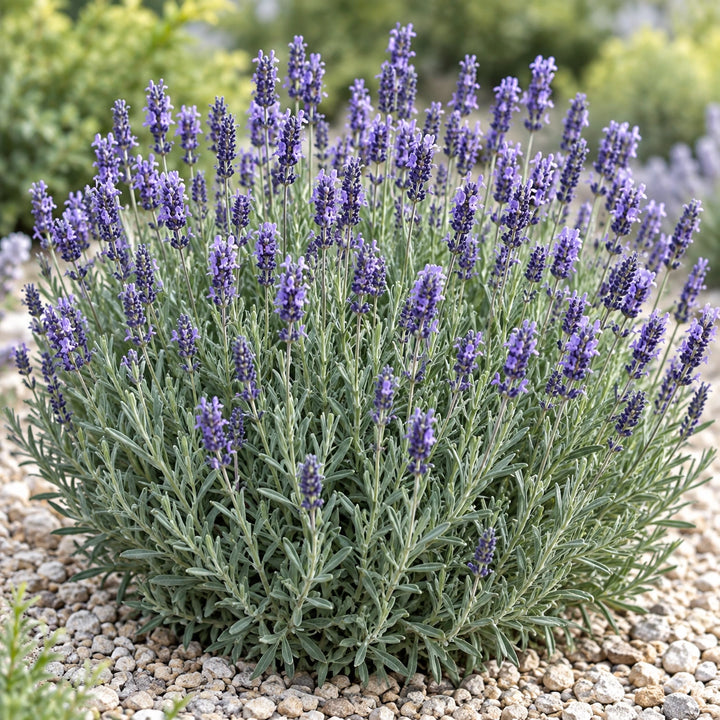
Provence Blue lavender is a lavandin, Lavandula × intermedia, with especially handsome silver-gray foliage and purple-blue spikes. It forms a bushy, mounding plant about 36 inches tall and wide and flowers a little earlier than many lavandins, starting in early July and peaking by mid-July.
The silver leaves do a lot of work. Even out of bloom, a row of Provence Blue looks bright and finished.
Provence Blue at a glance
| Trait | What to expect |
|---|---|
| Botanical name | Lavandula × intermedia 'Provence Blue' |
| Parentage | L. angustifolia × L. latifolia |
| Flower color | Purple-blue |
| Foliage | Silver-gray |
| Size | About 36 inches tall and wide |
| Bloom | Starts early July, peaks mid-July, one main flush |
| Hardiness | USDA zones 5a to 8b |
| Ratings | Excellent for oil, cut flowers, dried flowers and pollinators |
Provence Blue or Provence?
The names are close, and both are lavandins, but they are listed as separate cultivars. Provence Blue has purple-blue flowers over silver-gray foliage on a plant about three feet across. Provence is listed larger, up to about four feet wide, with lighter lavender flowers. If space is limited, Provence Blue is the more manageable of the two. The Compare tool shows them side by side.
Where it fits
Use Provence Blue for a silver-and-purple hedge along a walk, as a large accent in a gravel garden or in field rows for bundles and oil. Its silver foliage pairs beautifully with dark purple English lavenders, deep green shrubs and weathered wood. Because it peaks in mid-July, it overlaps with late English lavenders and leads into the August lavandins.
Planting and care
- Sun: full sun all day.
- Soil: lean, sandy or gravelly, and quick to drain. Raise rows in clay.
- Spacing: about three feet apart so air moves around each mound.
- Water: regularly during the first season, then rarely.
- Feeding: none. Rich soil makes lavandins sprawl.
- Winter: sharp drainage is the key to survival; keep wet mulch off the crown.
Confirm your zone with the USDA Zone Finder.
Harvest and pruning
Provence Blue puts on one main flush in July. For dried bundles, cut on a dry morning when about a third to half of the flowers on each spike have opened. Hang small bunches upside down in a dark, airy spot. After harvest, prune the plant back into a rounded mound, staying above the woody base where green growth remains. A yearly trim keeps it from splitting open.
Its fragrance is a strong floral-herbal lavandin scent, sweet lavender with fresh camphor notes, ideal for sachets and drawer bundles. It is rated good for culinary use, though lavandin is stronger and more camphor-forward than English lavender, so use a very light hand. Bees crowd it in bloom, and deer usually leave it alone.
It is offered as 3-inch plugs, 4-inch pots and 1-gallon pots. See the product page for current sizes and availability.
For a two-season effect, underplant a Provence Blue hedge with low spring bulbs that finish before the lavender fills out. The silver foliage then takes over as the bulbs fade.
Frequently asked questions
Is Provence Blue an English lavender?
No. It is a lavandin, a cross of English lavender and spike lavender, with bigger plants and more oil.
When does it bloom?
From early July, peaking in mid-July, with little rebloom.
Is it hardy in Michigan?
It is rated for zones 5a to 8b. Drainage, not cold, is usually the limiting factor.

































Share how it went in your field