

Product Field NotesLavender Plants
QL1 Lavender: A Tiny, Very Fragrant Spanish Lavender for Pots
 Save
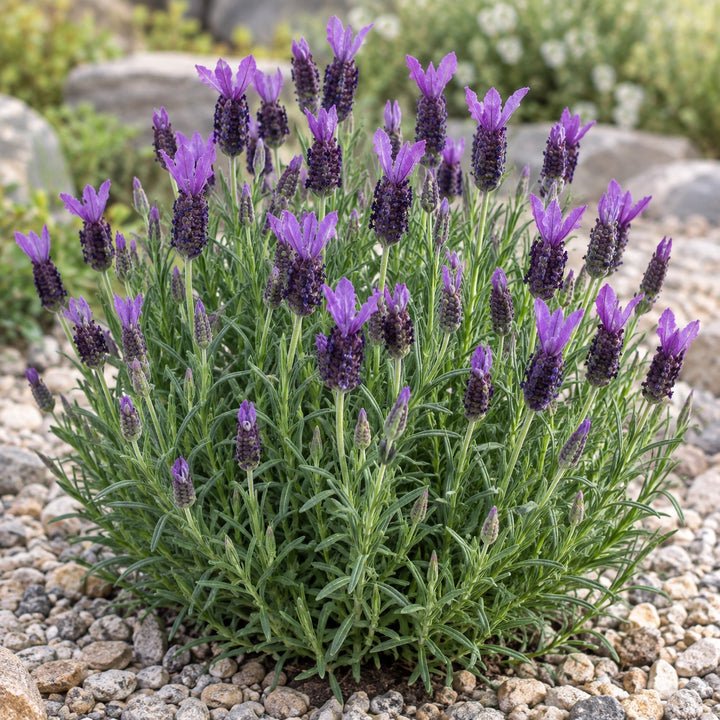
QL1 lavender is a small, dense Spanish lavender, Lavandula stoechas subsp. pedunculata, that tops out around ten inches tall and wide. It came out of an open-pollinated breeding block of more than fifty unnamed selections, so its exact parents are unknown, but its personality is very clear: violet bracts, darker violet true flowers and a scent rated exceptional.
It is the lavender equivalent of a pocket-sized dog with a big voice.
QL1 at a glance
| Trait | What to expect |
|---|---|
| Botanical name | Lavandula stoechas subsp. pedunculata 'QL1' |
| Flower color | Violet bracts over darker violet true flowers |
| Foliage | Green, with typical lavender scent |
| Habit | Dense and upright |
| Mature size | About 10 inches tall and 10 inches wide |
| Stems and heads | Short stems, about 1.5 inches, with flower heads about 2 inches long |
| Bloom | Starts mid-April, peaks early May; lesser flowering through summer and fall |
| Hardiness | USDA zone 9a |
| Fragrance | Exceptional; very strong flower scent |
Small plant, big scent
QL1's fragrance rating is the headline. The flower heads carry a very strong lavender scent and the foliage smells like lavender too, so even a single pot by a door or on a café table makes itself known. Because it stays so small, it is a good choice where space is tight: balcony rails, window boxes, a sunny kitchen sill in spring or a cluster of small pots on a step.
Container growing
A 6- to 8-inch pot is plenty for one plant. Use drainage holes, a fast-draining mix with added grit, and the sunniest spot you have. Small pots dry quickly in summer heat, so check them often, but always let the top of the mix dry before watering again. Lavender in a small pot drowns faster than it dries out.
- Deadhead: pinch off faded heads to keep the plant neat and nudge new flowers.
- Trim: after the spring flush, lightly shape the plant, staying above bare wood.
- Feed: very little. A weak dose of fertilizer once in spring is enough.
Winter care
With a hardiness listing of zone 9a, QL1 will not survive a northern winter outdoors. Move it inside before the first frost to a bright, cool spot, and water sparingly through winter. Good light and dry roots matter more than warmth. When nights warm up in spring, set it back outside gradually so it does not scorch. The USDA Zone Finder tells you what to expect in your area.
Using the flowers
The stems are short, so this is not a bundling lavender; its small-bundle rating reflects that. Still, it is rated good for fresh and dried use, and a few heads tucked into a small posy or dried for a sachet carry its strong scent well. It is rated great for pollinators. Culinary use is not recommended.
Frequently asked questions
Can I grow QL1 indoors year round?
It can live indoors for winter, but it does best outdoors in full sun for the warm months. Lavender grown inside all year tends to stretch and flower poorly.
Why is it called QL1?
It is a selection code rather than a descriptive name. The plant was chosen from a large open-pollinated breeding block of unnamed selections.
Will it flower more than once?
Yes. It has a main flush in spring, and its rebloom rating is high, with lighter flowering continuing through summer and fall.

































Share how it went in your field