

Use & Care NotesCompanion Plants
Rainforest Sunrise Hosta: A Small, Slug-Resistant Gold Hosta
 Save
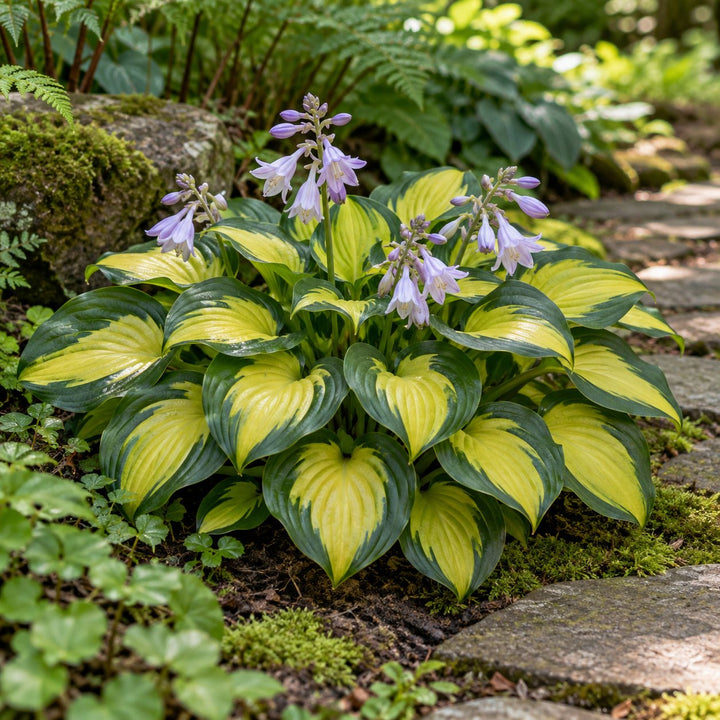
Rainforest Sunrise hosta is a small hosta with a lot of shine. Its rounded leaves come up plain light green, then quickly color up with radiant gold centers and wide, dark green borders. They are thick, glossy and a little puckered, and that thickness gives them a real advantage: slugs find them much harder going than most hostas.
It was named Hosta of the Year for 2013, and it stays tidy at about 8 inches tall, which makes it easy to tuck into small spaces.
Rainforest Sunrise at a glance
| Trait | What to expect |
|---|---|
| Botanical name | Hosta 'Rainforest Sunrise' |
| Foliage | Thick, glossy, cupped; gold centers with wide dark green margins |
| Flowers | Light lavender bells on scapes about 18 inches tall |
| Size | About 8 inches tall and 16 inches wide |
| Bloom | Early to mid-July |
| Hardiness | USDA zones 3 to 9 |
| Light | Part sun to full shade |
| Best uses | Edging, containers, small shade and rock gardens |
Where it fits
Lavender and hostas need opposite conditions, so plan them as neighbors on the same property rather than in the same bed. Rainforest Sunrise is especially useful along a shaded walk that leads toward a sunny lavender planting. A line of small gold mounds brightens the shade and draws the eye forward.
Its light lavender bells in July also tie it to the lavender garden in color, even if the two never share soil. Lay out both areas in the Companion Plant Planner.
How much sun it can take
Here is a small hosta that likes a little light. Gentle morning sun makes the gold centers glow. The line to avoid is hot afternoon sun, which can scorch the leaves. An east-facing bed or the dappled edge of a tree canopy is ideal.
Care through the year
- Soil: rich, humus-heavy and evenly moist, but well drained so the crown never sits wet.
- Water: deeply in dry spells, especially in its first summer.
- After bloom: cut the spent scapes to keep the mound neat.
- Fall: clear the foliage after a hard frost.
- Dividing: small hostas fill in slowly; divide only when crowded, in early spring as shoots appear.
Choosing a tray
It is offered as a 72-cell plug tray for larger plantings and growers, and as a deep 20-cell tray with larger plugs. See each product page for current availability, or the Wholesale Hub for more trays.
Frequently asked questions
Will slugs leave it alone?
The thick leaves resist slug damage better than most hostas. In a very wet season you may still see a few holes, but far fewer than on thin-leaved types.
Can I grow it in a pot?
Yes. Its small size suits containers. Use a pot with drainage and water more often in summer.
Is it safe around pets?
Hosta foliage is listed as toxic to dogs and cats, so keep it out of chewing range.
















Share how it went in your field