

Use & Care NotesLavender Plants
Royal Purple Lavender: A 1944 English Classic with Big Fragrance
 Save
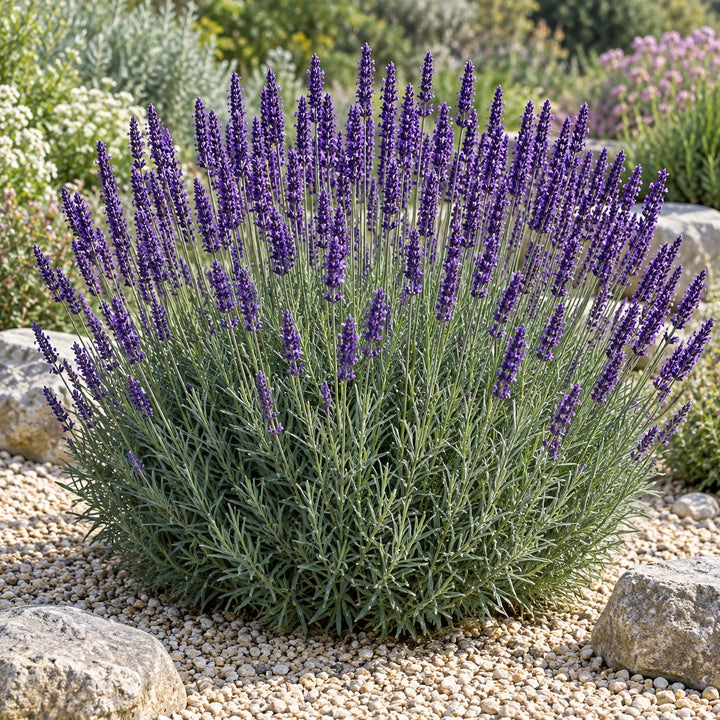
Royal Purple lavender is an English lavender that has been in gardens since 1944, and it has kept its place for good reasons. The flowers are a rich, saturated purple, the fragrance is rated exceptional, and the plant grows into a broad, bushy evergreen shrub with gray-green foliage and stems around 16 inches long.
It is a lavender with some reach. Plan for width.
Royal Purple at a glance
| Trait | What to expect |
|---|---|
| Botanical name | Lavandula angustifolia 'Royal Purple' |
| Introduced | 1944 |
| Flower color | Rich purple |
| Foliage | Gray-green |
| Habit | Bushy evergreen shrub |
| Mature size | About 30 to 39 inches tall and up to about 59 inches wide |
| Stem length | About 16 inches |
| Bloom | Starts mid-June to early July, peaks mid-July, moderate rebloom |
| Hardiness | USDA zones 5a to 9b |
| Fragrance | Exceptional |
A note on size
Royal Purple's records do not agree on height: the listing describes about 30 inches, while its detailed measurements put it closer to 39 inches. Both agree it gets wide, up to roughly five feet. Climate, soil and pruning all play a part, so check the listing for the current size and plan your spacing for a big plant. A yearly trim keeps it on the more compact end.
Where it works
Its width and dense, bushy shape make Royal Purple a strong hedge lavender. A row along a sunny drive or property line fills in into a continuous purple band by midsummer. It also works as a single specimen shrub in a sunny border. The rich purple reads well from a distance, which is why older cultivars like this one have long been used where color needs to carry.
Planting and care
- Sun and soil: full sun with fast-draining sandy or loamy soil. Raise beds or rows in clay.
- Spacing: about four to five feet apart for individual shrubs; a little closer for a hedge that knits together.
- Water: deeply through the first season, then sparingly. Water needs are low once established.
- Feeding: skip it in most soils.
- Winter: drainage first. Keep wet mulch and leaf piles off the crown.
The Care Calendar lays out what to do each month.
Pruning a big English lavender
Large English lavenders open up in the center if they are left unpruned for a few years. After the main bloom, cut the flower stems and take back about a third of the leafy growth, shaping a dome. Never cut into bare wood. This yearly habit keeps Royal Purple full, encourages moderate rebloom and extends the plant's useful life.
Harvesting the fragrance
Exceptional fragrance and a great culinary rating make Royal Purple a strong all-around harvest plant. Its 16-inch stems are long enough for proper bundles. Cut when buds are fully colored and the first flowers are just opening, then hang to dry in the shade. For baking, strip the dried buds and use them sparingly; for sachets and drawer bundles, the deep color and scent hold well. It is rated excellent for essential oil suitability, too.
Frequently asked questions
Is Royal Purple good for cooking?
Yes. It is an English lavender rated great for culinary use. Use food-grown buds and start with small amounts.
How tall does it get?
Listed figures range from about 30 to 39 inches tall, with a spread up to about 59 inches. Regular pruning keeps it more compact.
When does it bloom?
Records place the start between mid-June and early July, with a mid-July peak. Your garden's weather sets the exact timing.
Keep exploring
Ready to plant it?
Sizes, prices and shipping times are on its page.

















Share how it went in your field