

Use & Care NotesCompanion Plants
Royal Rembrandt Speedwell: Violet Brushes at the Bed's Edge
 Save
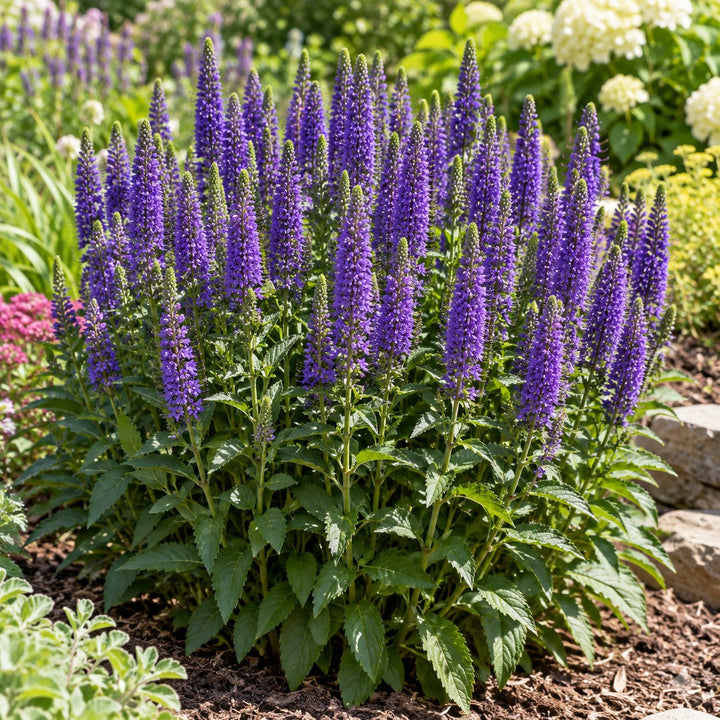
Royal Rembrandt spike speedwell is a dependable Veronica with thick, paintbrush-like spikes of tiny violet-purple florets, closer to true violet than many blue speedwells. The spikes cover the top half of a tight, rounded clump of dark green leaves, and the plant stays tidy at about 18 to 20 inches tall and wide. Bees love it.
Royal Rembrandt at a glance
| Trait | What to expect |
|---|---|
| Botanical name | Veronica 'Royal Rembrandt' |
| Flowers | Violet-purple spikes, 4 to 8 inches long |
| Foliage | Dark green, lance-shaped, finely toothed |
| Size | 18 to 20 inches tall and wide |
| Bloom | Starts early July, peaks late July, long blooming with rebloom |
| Hardiness | USDA zones 4 to 8 |
| Light | Full sun to part shade |
| Wildlife | Excellent for pollinators; deer resistant |
A spike that echoes lavender
Speedwell and lavender share a shape: upright spikes of small flowers in the purple family. That makes Royal Rembrandt one of the easiest ways to repeat lavender's look in a part of the bed with slightly different conditions. Its violet is a touch bluer and more saturated, so the two read as related but not identical.
The difference is water. Speedwell likes soil that does not stay dry for long, while lavender wants to dry out. Plant Royal Rembrandt along the outer edge of the lavender bed, or where the soil holds a little more moisture, and water it there during dry spells without soaking the lavender. It begins blooming in early July and carries spiky purple color past the lavender harvest. Lay it out in the Companion Plant Planner.
Planting and care
- Site: full sun to part shade in average, well-drained soil.
- Water: steady moisture through summer. In hot, dry spells bloom slows and lower leaves may brown.
- Deadheading: cut each spent spike back to the next set of side buds to keep new spikes coming.
- Rebloom: shear it back after the first flush for a later round.
- Airflow: space plants to limit powdery and downy mildew.
- Dividing: split crowded clumps every few years in spring.
Winter
Royal Rembrandt is hardy in Michigan within its zone range. Cut back the spent stems in fall or early spring, and keep it out of spots where water stands in winter, since crown rot is the main cold-season risk.
For cutting
The spikes rate good as cut flowers and last well in a vase. Mixed with fresh lavender and a few white blooms, they make an easy all-purple bouquet. Plan a cutting bed in the Cut Flower Planner.
Frequently asked questions
Is it bigger or smaller than lavender?
About the same height as many English lavenders, at 18 to 20 inches, so it sits comfortably beside them.
How is it offered?
As a full 72-cell plug tray. See the product page for current availability.
















Share how it went in your field