

Product Field NotesCompanion Plants
Silver Lining Artemisia: A Wide Silver Cushion That Holds Its Shape
 Save
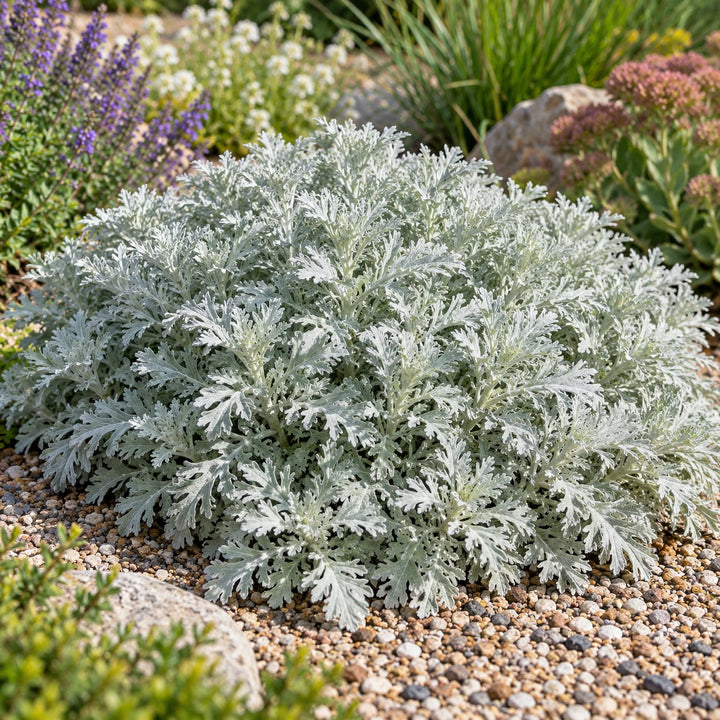
Silver Lining artemisia is grown for its leaves: broadly cut, deeply lobed and covered in fine hairs that turn them a soft, bright silver-white. They layer into a low, wide dome about a foot tall and close to three feet across, and the mound stays full all season instead of flopping open in the center.
It was named best of its species in university trials, and it does not run underground the way some silver artemisias do, which is very good news for the lavender planted next to it.
Silver Lining at a glance
| Trait | What to expect |
|---|---|
| Botanical name | Artemisia 'Silver Lining' |
| Foliage | Bright silver-white, deeply lobed, 2 to 4 inch leaves |
| Flowers | Small buff yellow, insignificant |
| Size | 12 to 16 inches tall, 32 to 36 inches wide |
| Hardiness | USDA zones 4 to 9 |
| Light | Full sun |
| Scent | Sharp, sage-like when brushed |
| Wildlife | Deer and rabbit resistant |
The Mediterranean look, Michigan tough
Silver foliage and purple flowers is the classic dry-garden combination, and it works because the plants want the same things. Silver Lining loves heat, drought and poor soil, exactly what lavender wants. Its broad, soft-textured mound sits low enough to place in front of lavender or between plants, where it fills gaps and makes every purple spike look sharper.
It also bridges the gap between lavender's bloom periods. Before bloom, after the summer trim and through fall, the bed still has a strong silver presence. Brush past it and you get a sharp, sage-like scent to go with lavender's sweeter one.
Because it spreads nearly three feet, allow it room. Let it be the groundcover between lavender rows, an edging along a hot walk, or a spiller tumbling from a big sunny container.
Care
- Soil: lean and very well drained. Rich soil and wet feet are what ruin silver artemisias.
- Water: only until established. Avoid beds that are irrigated heavily in hot weather.
- Humidity: like most silver artemisias it can open up or rot in humid, wet summers. Good drainage and airflow are the answer.
- Spring: trim lightly once new growth starts to refresh the mound.
- Winter: hardy in Michigan in sharply drained soil; wet winter soil is the main cause of loss.
Rust is the other occasional concern, mostly in wet, crowded sites. Check the Plant Health Checker if spots appear.
Choosing a tray
Silver Lining is offered as a 72-cell plug tray and as a 20-cell plug tray. The 72-cell tray suits growers and long edgings, and the 20-cell tray gives fewer, larger plugs that fill in faster. See each product page for current availability.
Frequently asked questions
Will it spread through my lavender bed?
It widens into a broad mound but does not send out invasive underground runners like some artemisias.
Does it flower?
Thin stalks with small buff yellow flowers may appear in late summer, but it is grown for foliage. Snip them off if you prefer a clean silver look.
Can I use it in the kitchen?
No. It is an ornamental, and artemisia foliage is bitter.















Share how it went in your field