

Product Field NotesCompanion Plants
Silverine Hen and Chicks: Frosted Rosettes for Lavender's Edge
 Save
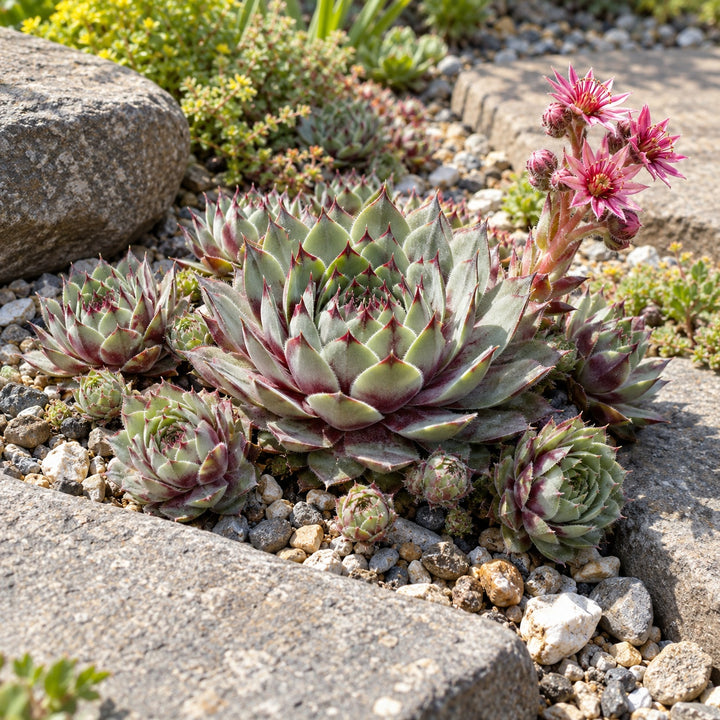
Silverine hen and chicks forms symmetrical rosettes 2 to 4 inches across of thick, sharply pointed leaves in silvery green, each flushed reddish purple at the base. Smaller chicks cluster around the main hen, and a group looks like a scatter of frosted stars with purple hearts. The coloring shifts with the seasons, so it never looks quite the same twice.
It is about as low-care as a plant can be, and it loves the same lean, sun-baked ground as lavender.
Silverine at a glance
| Trait | What to expect |
|---|---|
| Botanical name | Sempervivum 'Silverine' |
| Foliage | Silvery green, flushed reddish purple at the base |
| Flowers | Deep pink stars on short, leafy stalks in summer |
| Size | 3 to 4 inches tall, clusters 6 to 8 inches wide |
| Hardiness | USDA zones 3 to 8 |
| Light | Full sun |
| Water | Very little once established |
| Wildlife | Deer resistant |
Where it fits around lavender
Lavender beds often have bare spots along the edge, between stepping stones or in the gravel mulch many growers use to keep crowns dry. Silverine fills those spots without competing. Its low, sculptural rosettes contrast with lavender's tall, airy spikes, and the silvery green ties in with lavender's foliage. Because it stays only a few inches tall, it never shades the lavender or crowds its base.
It also handles places lavender cannot: wall crevices, the cracks in a stone step, the top of a dry stone wall. Together they make a dry, sunny garden look planted from top to bottom.
Planting and care
- Soil: poor to average with sharp drainage, such as gravel, sand, rock crevices or a shallow container with gritty mix.
- Water: very little. It rots in wet soil, and constant wet plus humidity is the main cause of loss.
- Summer: rosettes may close up and lose a bit of color in the hottest weeks, then recover in fall.
- Winter: fully hardy in Michigan and evergreen. Do not mulch over it.
- Pests: watch for mealybugs and vine weevil larvae.
When a hen flowers
In summer some mature rosettes send up a short, leafy stalk topped with deep pink star-shaped flowers. That rosette dies after blooming; it is the plant's natural cycle, not your fault. Cut off the spent stalk, pull out the old rosette and let the surrounding chicks fill the gap. Extra chicks can be popped off and replanted anywhere you want more.
Bare root format
Silverine is offered as a bare root plant. Set the rosette on top of gritty soil with the roots just covered, firm it in and give it a light watering. See the product page for current availability.
Frequently asked questions
Can it grow in a pot?
Yes. A shallow container with drainage and gritty mix is ideal, and it looks good next to a potted lavender.
Why are my rosettes closing up?
It is a normal response to heat and dry weather. They open again as temperatures ease.
Do I need to feed it?
No. Poor soil keeps the rosettes compact and colorful.















Share how it went in your field