

Product Field NotesCompanion Plants
Snowcap Shasta Daisy: A Compact White Edging for Purple Lavender
 Save
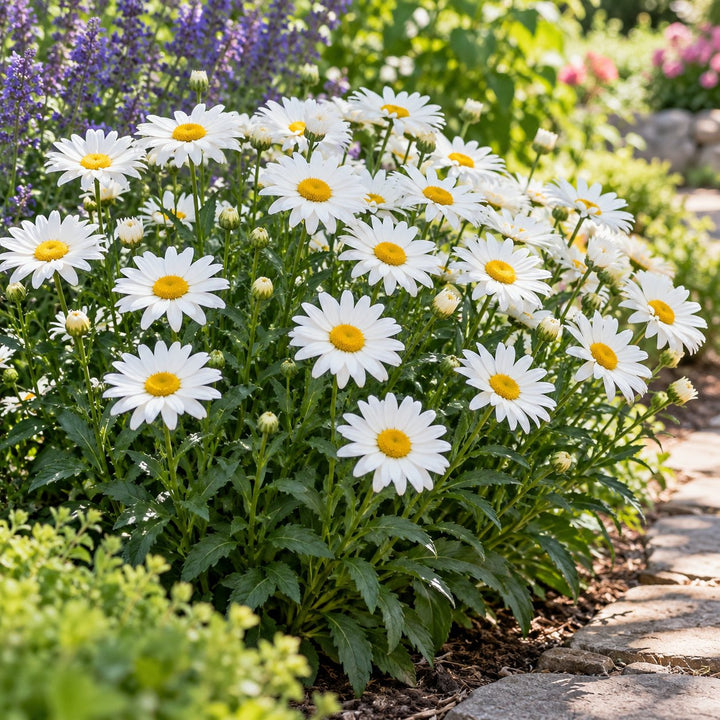
Snowcap Shasta daisy is the compact, long-established dwarf of the Shasta world. It forms a bushy, uniform mound 12 to 15 inches tall of glossy dark green leaves, and from mid-June it covers itself in 2 to 3 inch pure white single daisies with golden centers.
Its short, sturdy stems stand up to wind and rain better than tall daisies, so it rarely needs staking. In other words, it stays where you put it, which is more than you can say for some garden plants.
Snowcap at a glance
| Trait | What to expect |
|---|---|
| Botanical name | Leucanthemum × superbum 'Snowcap' |
| Flowers | Pure white singles with golden centers, 2 to 3 inches |
| Foliage | Glossy dark green, lance-shaped |
| Size | 12 to 15 inches tall, about 12 inches wide |
| Bloom | Starts mid-June, peaks early July, into late summer with deadheading |
| Hardiness | USDA zones 5 to 9 |
| Light | Full sun |
| Wildlife | Good for pollinators; moderately deer resistant |
White daisies in front of lavender
Snowcap's size is its gift. At about a foot tall and wide, it sits in front of most lavenders without hiding them, making a crisp white edge that brightens the purple behind it. Bloom begins in mid-June, overlapping lavender's season, and the glossy foliage stays neat after flowering, so the edging looks tidy all summer.
For a classic cottage look, alternate Snowcap with a low, compact lavender along a path. For a more formal one, run a continuous row of Snowcap in front of a hedge of taller lavender. Either way, keep a small gap between daisy and lavender so lavender crowns stay dry and airy. Sketch it in the Companion Plant Planner.
Keeping it blooming
- Deadhead: snip spent flowers back to the next bud. Regular deadheading keeps it going for months.
- Water: during dry spells, at the base. It appreciates more moisture than lavender in extreme heat, so water the daisy, not the whole bed.
- Airflow: wet foliage and soggy soil in humid weather encourage leaf spot and crown rot.
- Pests: aphids and four-lined plant bug can disfigure the leaves; check plants in early summer.
- Fall: cut flowering stems, but leave the basal leaves in place over winter.
- Every 2 to 3 years: divide in spring to keep it vigorous.
Containers and small bouquets
Its uniform size makes Snowcap a good container plant, especially paired with a potted lavender in a sunny spot. The short stems limit it as a cut flower, but a handful in a small jar with lavender sprigs looks charming on a table.
Format
Snowcap is offered as a full 72-cell plug tray, ideal for long edgings, mass plantings and growers. See the product page for current availability.
Frequently asked questions
How is Snowcap different from taller Shasta daisies?
It stays 12 to 15 inches with short, sturdy stems, so it rarely needs staking and suits edging and containers.
Why did my daisies disappear after winter?
Crown rot in wet, heavy soil causes most winter losses. Good drainage is the key.
Do I have to divide it?
Dividing every two to three years keeps the clump vigorous and blooming well.

































Share how it went in your field