

Product Field NotesCompanion Plants
Spinderella Hardy Hibiscus: Pink Pinwheels for a Watered Border
 Save
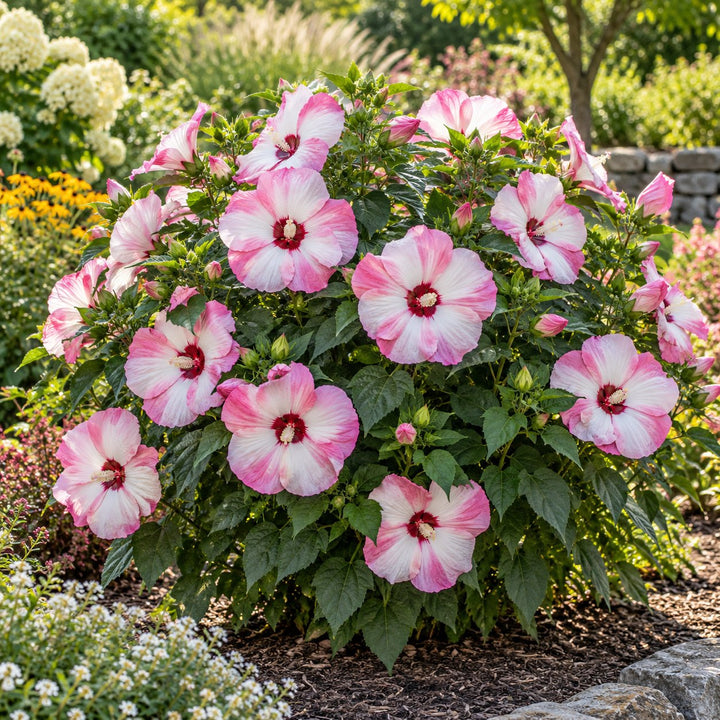
Spinderella hardy hibiscus makes a lively late-summer statement. Its flowers are about eight inches across, white with a medium pink band on the edge of each petal, arranged in a pinwheel pattern around a dark red eye. They are spread over a tidy, dense, well-rounded bush of dark green leaves, a clear improvement in form over older hibiscus with this flower type.
It loves full sun as lavender does, but it needs far more moisture. That means it belongs in its own watered border, not in the lavender bed.
Spinderella at a glance
| Trait | What to expect |
|---|---|
| Botanical name | Hibiscus 'Spinderella' |
| Flowers | White with pink edges and a dark red eye, about 8 inches |
| Foliage | Dark green |
| Size | 4 to 4½ feet tall, 4½ to 5 feet wide |
| Bloom | Starts mid-July, peaks mid-August, into early fall |
| Hardiness | USDA zones 4 to 9 |
| Light | Full sun; tolerates part shade |
| Wildlife | Great for pollinators and hummingbirds; moderately deer resistant |
Planning it into a lavender garden
Lavender and hardy hibiscus are both sun lovers, but they sit at opposite ends of the water scale. Lavender rots in wet soil; hibiscus comes from wetland parents and wilts when the soil dries out. The answer is to give each its own place in the same sunny yard. Spinderella works well in a low spot that collects water, along a downspout, by a pond edge or in a rain garden, while lavender holds the high, sharp-draining ground.
Its timing also complements lavender. The pinwheel flowers start in midsummer, as lavender's main bloom is finishing, and carry on into early fall, keeping the garden colorful after the harvest. As a centerpiece for a sunny, moist bed, few perennials are as showy. Map wet and dry zones in the Companion Plant Planner.
Care through the season
- Water: consistent moisture. Flowering slows and leaves may wilt in hot spells if the soil dries out.
- Soil: grows in poor to fertile soil as long as it stays moist.
- Sun: full sun for the most flowers.
- Pests: Japanese beetles, aphids and sawfly larvae are more common problems than disease; leaf spots and rust can appear in wet seasons.
- Spring: very late to emerge, often not until late May or June. Mark its spot and do not dig it up.
- Fall or early spring: cut the woody stems back to a few inches.
Plug tray or bare root
Spinderella is offered as a 72-cell plug tray for growers and larger plantings, and as a bare root plant for a single specimen. See each product page for current availability.
Frequently asked questions
Can I plant it in my lavender bed?
It is better not to. Lavender needs dry soil, and Spinderella needs consistent moisture. Watering one would harm the other.
My hibiscus has not come up. Is it dead?
Probably not. Hardy hibiscus is very late to emerge, often not until late May or June in Michigan.
Do the flowers last?
Individual blooms are short-lived, but the plant keeps opening new ones from midsummer into early fall. They are not suited to cutting.

































Share how it went in your field