

Use & Care NotesLavender Plants
Sweetberry Ruffles Lavender: Bracts That Shift from Peach to Plum
 Save
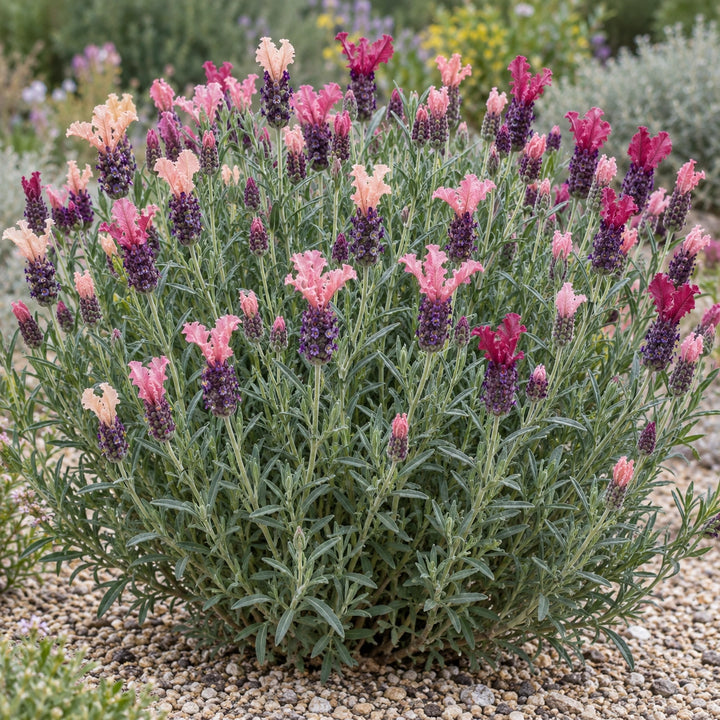
Sweetberry Ruffles lavender cannot make up its mind about color, and that is the fun of it. The petal-like bracts on top of each flower head open in pale pink and light peach tones and deepen toward red-purple as they age, so one plant can show several shades at the same time.
It is a Spanish lavender, Lavandula stoechas 'Sweetberry Ruffles', part of the Ruffles series and introduced in 2007. Its listed parents are 'Winter Lace' and 'Boysenberry Ruffles', which makes it a sibling of Strawberry Ruffles.
Sweetberry Ruffles at a glance
| Trait | What to expect |
|---|---|
| Botanical name | Lavandula stoechas 'Sweetberry Ruffles' |
| Bract color | Light peach and pale pink, aging to red-purple |
| Foliage | Gray-green |
| Size | About 24 inches tall and 32 inches wide in the ground |
| Bloom | Starts early May, peaks late May, high rebloom |
| Hardiness | USDA zones 8a to 8b |
| Fragrance | Moderate, from fragrant flower spikes |
| Best uses | Containers, pollinators, fresh bouquets, dried flowers |
Making the most of the color shift
Because the bracts change as they age, Sweetberry Ruffles looks best where you can see it up close: a pot on the patio table, a planter by the front step, or a window box at eye level. Pair it with plain, cool-toned neighbors so the peach and berry shades stand out. Silver-leaved herbs, white flowers and blue-gray foliage all make good backdrops.
Its pollinator rating is great, so expect bees, and deer usually ignore it.
Container setup
- Choose a pot with a large drainage hole. Unglazed clay is a good choice because it breathes and dries evenly.
- Fill with a fast-draining potting mix with extra grit or perlite.
- Set the pot in full sun, six or more hours a day.
- Water thoroughly, let the top inch or two dry, then water again. Skip saucers that hold water.
- Feed lightly in spring; too much fertilizer means leaves instead of flowers.
Deadheading for repeat bloom
Spanish lavender does not need a winter chill to bloom, and Sweetberry Ruffles has a high rebloom rating. When a wave of heads fades and the bracts dry, cut those stems back to the leafy growth. After the big spring flush, a light shaping trim keeps the plant compact. Avoid cutting into old, leafless wood.
Getting through winter
Zones 8a to 8b means a Michigan winter outdoors is too much for it. Before a hard frost, move the pot into a bright, cool, frost-free space, keep it on the dry side, and bring it back out after your last frost date. Check your timing with the Frost Date Estimator. If overwintering is not for you, it is a long-blooming seasonal plant that earns its spot for one summer.
Cutting and drying
The short stems suit small vases and posies. Cut a few at different stages to capture the range of colors in one jar. Both its cut-flower and dried-flower ratings are good. Spanish lavender is ornamental, so it is not recommended for cooking.
Choosing a plant size
It is offered as 3-inch plugs, 4-inch pots and 1-gallon pots. See the product page for current sizes and availability, and use Notify Me there if the size you want is not ready.
Frequently asked questions
Why are the flowers different colors on one plant?
The bracts shift from peach and pale pink to red-purple as they age, so heads at different stages show different shades.
Is Sweetberry Ruffles the same as Strawberry Ruffles?
No. They share listed parents and a series, but Strawberry Ruffles stays in the pink and mauve range while Sweetberry shifts from peach to red-purple.
Can it stay outside all winter in Michigan?
No. It is rated for zones 8a to 8b, so protect it from hard frost or grow it as a seasonal plant.
















Share how it went in your field