

Product Field NotesCompanion Plants
Tanager Coneflower: Tangerine Orange Against Purple Lavender
 Save
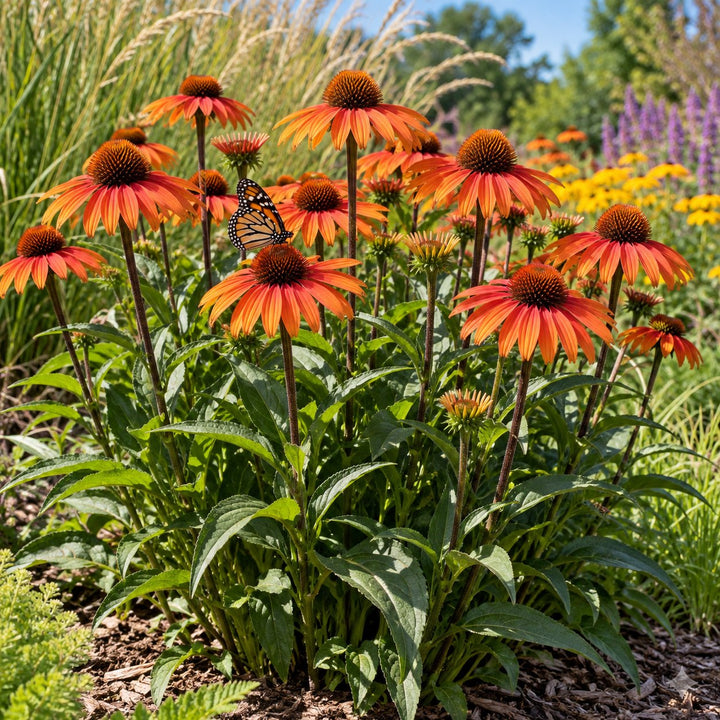
Tanager coneflower carries vivid tangerine orange flowers about 3.5 inches wide, with broad, heavily overlapping petals held out flat around a raised dark cone. The blooms sit on dark stems above dark green leaves, so the orange looks even hotter.
Plants branch freely from the base and produce many flowers at once from midsummer into late summer on a sturdy clump about two feet tall.
Tanager at a glance
| Trait | What to expect |
|---|---|
| Botanical name | Echinacea 'Tanager' |
| Flowers | Rich tangerine orange, about 3.5 inches, dark cone |
| Fragrance | Faint, lightly sweet and honey-like |
| Size | 22 to 24 inches tall, 16 to 18 inches wide |
| Bloom | Starts early July, peaks late July, into late summer |
| Hardiness | USDA zones 4 to 8 |
| Light | Full sun to light part shade |
| Wildlife | Excellent for pollinators; deer resistant |
Orange and purple: a confident pairing
Orange sits opposite blue-violet on the color wheel, so tangerine coneflowers make lavender look deeper and cooler. It is not a subtle combination, and that is the point. Tanager opens in early July as lavender peaks, and keeps flowering after the lavender is cut, so the bed stays lively into late summer.
It also suits the site. Coneflowers thrive in the same full sun and lean, well-drained soil as lavender, and they handle heat and dry spells once established. Plant Tanager in groups of three between lavender mounds or just behind them, leaving room for air around each plant. Try the layout in the Companion Plant Planner.
Getting hybrid coneflowers through winter
Hybrid coneflowers are most often lost to wet winter soil, not cold. A few habits help Tanager come back strong:
- Plant by late summer so roots establish before the ground freezes.
- Choose sharp drainage. A spot that suits lavender suits Tanager.
- Leave stems standing over winter, and avoid heavy mulch over the crown.
- Do not overfeed. Lean soil keeps the clump compact and long-lived.
Care in the growing season
- Deadheading: cut spent flowers back to a side bud to keep new ones coming.
- Aster yellows: this leafhopper-spread disease causes distorted green flowers. Remove affected plants promptly.
- Other issues: crown and root rot in wet soil, and occasional powdery mildew or Botrytis.
Cutting, drying and the birds
Tanager rates good both as a cut flower and dried. Orange coneflowers and fresh lavender make a bright summer bouquet, and dried cones add texture to winter arrangements. Late in the season, let some flowers go to seed. Finches will find them, and you will get a little free entertainment from the kitchen window.
Plug tray
Tanager is offered as a 72-cell plug tray. See the product page for current availability, or the Wholesale Hub for tray orders.
Frequently asked questions
Do the petals droop as they age?
No. Tanager's petals stay nearly horizontal as the flowers age.
Can I grow it in a pot?
Yes, containers are one of its listed uses. Use a gritty, well-drained mix.

































Share how it went in your field