

Use & Care NotesCompanion Plants
Terms of Endearment Hosta: A Blue Giant with a Clean Gold Edge
 Save
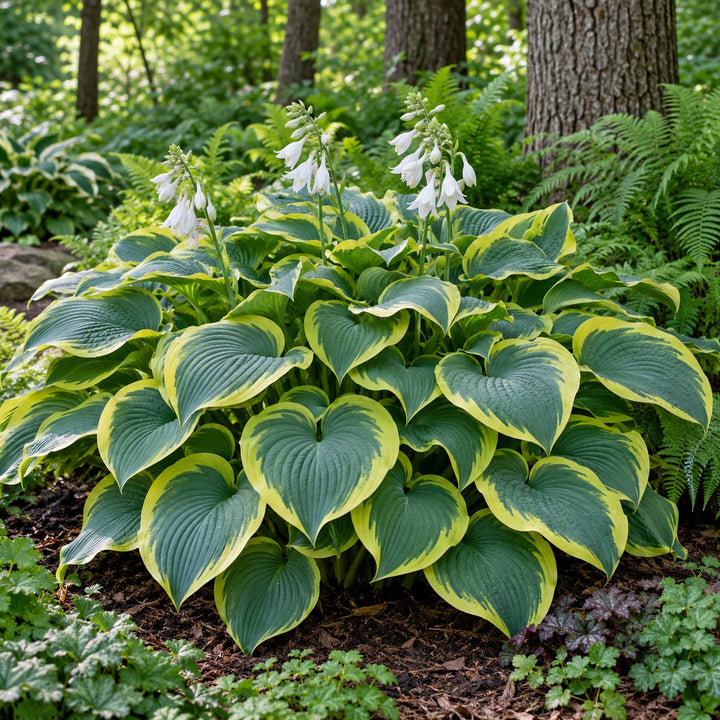
Terms of Endearment hosta has large, rounded, heart-shaped leaves in blue-green, moderately puckered, with a smooth, even yellow margin. It was offered as an improvement on the old favorite 'Frances Williams', because its yellow edge does not scorch and brown the way that classic's often does.
It builds a big mound, about 29 inches tall and 5 1/2 feet wide, with white bells peeking just above the leaves in early summer.
Terms of Endearment at a glance
| Trait | What to expect |
|---|---|
| Botanical name | Hosta 'Terms of Endearment' |
| Foliage | Blue-green, puckered, smooth yellow margin |
| Flowers | White bells on scapes 25 to 36 inches tall |
| Size | About 29 inches tall, 66 inches wide |
| Bloom | Starts mid-June, peaks early July |
| Hardiness | USDA zones 3 to 9 |
| Light | Part to full shade |
| Deer | Susceptible |
A focal point for the shady half of the plan
Let us be straightforward: hostas and lavender should never share a bed. Lavender wants full sun and dry, lean soil; Terms of Endearment wants shade and rich, moist soil. Each would ruin the other's conditions.
What they can share is a garden plan. A sunny lavender bed out front and a shady woodland bed under the trees are two halves of the same yard. In the shade half, Terms of Endearment is a natural centerpiece, wide enough to anchor a bed by itself. Its blue-green leaves bring the cool tones of the lavender side into the shade, and the clean yellow edge brightens dark corners. Plan both areas in the Companion Plant Planner.
Planting for a 5-foot mound
- Spacing: give it at least 5 1/2 feet. Small plugs look lonely at first; fill the gap with ferns or annuals for a few seasons.
- Soil: rich, humus-heavy and evenly moist but well drained.
- Water: water deeply during dry spells, especially the first summer.
- Bloom: cut spent scapes after flowering.
- Dividing: divide crowded clumps in early spring as shoots emerge.
Leaves that hold up
The thick leaves resist slugs better than many hostas, and the margins were bred to avoid the browning common in 'Frances Williams'. Watch for Hosta Virus X, which shows as mottled, streaked leaves, and discard affected plants. In winter, it is fully hardy in Michigan; cut the large leaves down after a hard frost and avoid heavy, wet mulch over the crown.
Plug tray sizes
Terms of Endearment is offered in 72-cell and 20-cell plug trays. See each product page for current availability, or the Wholesale Hub for tray orders.
Frequently asked questions
How long until it reaches full size?
Large hostas take several seasons to fill out. Give it time, steady moisture and room.
Is it safe for pets?
Hosta foliage is listed as toxic to dogs and cats.
Will deer eat it?
Yes, hostas are deer susceptible. Protect it in deer country.
















Share how it went in your field