

Product Field NotesCompanion Plants
Variegatum Solomon's Seal: Arching Cream-Edged Wands for Shade
 Save
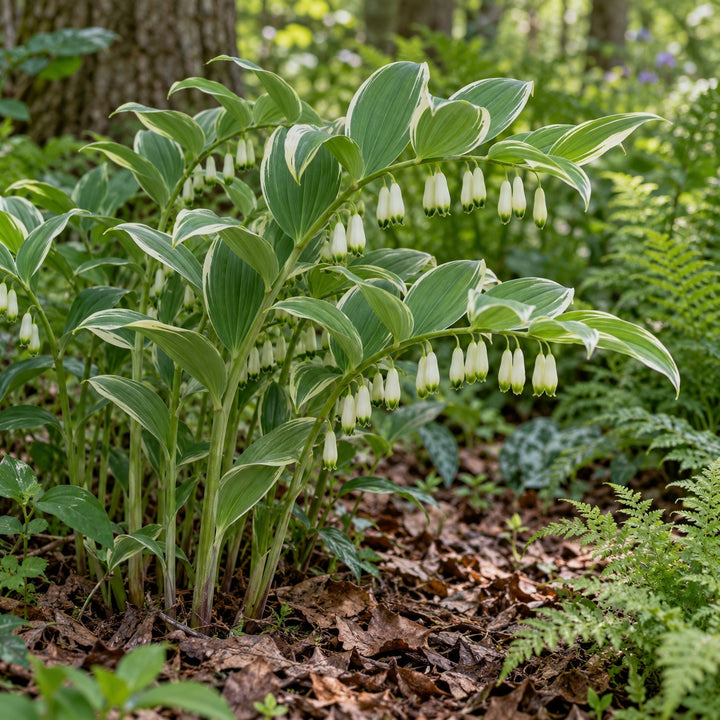
Variegatum Solomon's seal is one of those plants that makes a shade garden look like it has been there for decades. Unbranched stems arch gracefully to about 2 feet, lined with soft green leaves neatly edged in creamy white. In late spring, small white bells tipped in green dangle beneath each stem and give off a light, lily-like scent in the evening.
It was named Perennial Plant of the Year in 2013 for its long season of foliage interest. It also has no interest in sunshine, which is where it parts ways with lavender.
At a glance
| Trait | What to expect |
|---|---|
| Botanical name | Polygonatum odoratum var. pluriflorum 'Variegatum' |
| Foliage | Soft green edged creamy white, turning yellow in fall |
| Flowers | Small white bells with green tips, lightly scented |
| Size | 18 to 24 inches tall, 10 to 20 inches wide, slowly spreading |
| Bloom | Mid to late May |
| Hardiness | USDA zones 3 to 9 |
| Light | Part shade to full shade |
| Deer | Moderately resistant |
Its place in a lavender garden
A garden built around lavender usually has its sunny showpiece and a shady corner nobody quite knows what to do with. Variegatum is the answer for that corner. Where lavender gives you mounded silver and purple in hot sun, Solomon's seal gives you tall, arching lines and cream-and-green leaves in cool shade. Different plants, same calm, tidy mood.
Do not try to bridge the gap by planting it at the edge of the lavender. In dry soil or afternoon sun, its leaves brown at the edges and the plant can go dormant early. Use the Companion Plant Planner to place it with hostas, ferns and lungwort instead.
Planting the bare root
Solomon's seal grows from creeping rhizomes. Lay the rhizome horizontally about an inch or two deep in rich, loose soil with the buds pointing up, cover it and water well. It spreads slowly into a colony, so give it time; the second and third years are when it starts to look established.
Care through the year
- Spring: stems emerge and bells hang beneath them in May. No deadheading needed.
- Summer: keep the soil evenly moist, especially during dry spells.
- Fall: leaves turn a clear yellow, then the plant dies back.
- Winter: leave fallen leaves as a natural mulch; cut stems down in late fall or spring.
It has few serious problems. Slugs and snails can chew leaves in wet weather, and poor growing conditions can bring leaf spots or mildew.
In arrangements
The arching stems are lovely in fresh bouquets, adding movement and a cream-and-green accent. Blue-black berries may follow the flowers. Note that all parts, especially the berries, are considered toxic if eaten, so keep them away from children and pets.
Frequently asked questions
Does it smell?
The flowers have a light, sweet, lily-like scent, most noticeable in the evening.
Will it spread too much?
It spreads slowly by rhizomes into a clump or small colony, not aggressively.
Can it grow in dry shade?
It prefers evenly moist soil. In dry shade it may brown and go dormant early, so water it during dry spells.

































Share how it went in your field