

 Open in the Field Guide
We all need a Savior
“For all have sinned and fall short of the glory of God.”
Romans 3:23 (BSB)
None of us can earn our way to God by being good enough. We all need mercy.
 Field Guide · Plants and flowers
Oxalis pes-caprae

The leaves contain oxalic acid and can be harmful if eaten in large amounts, especially for people with kidney problems.
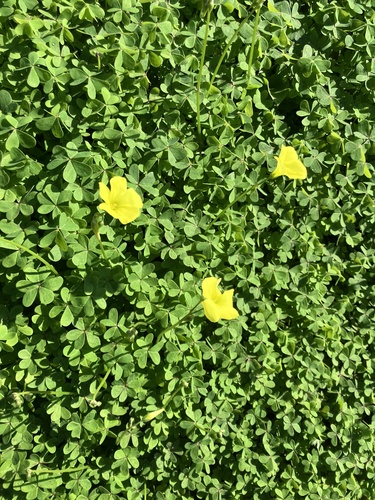
Bermuda buttercup is a bulb-forming plant in the wood-sorrel family, native to South Africa. It has spread to many regions with mild climates, including parts of California and the Mediterranean, where it can become invasive.
 How to recognize it
Look for clusters of bright yellow flowers above three heart-shaped leaflets; unlike the listed wood-sorrels, it grows from bulbs and usually has larger, showier flower clusters. The similar species include small white-flowered O. acetosella and creeping or more upright yellow-flowered species such as O. corniculata and O. stricta.
 In lavender fields
It can grow as a weed in gardens near lavender, but is not a notable lavender companion or pollinator plant.
 When to see it
Bermuda Buttercup is seen most often in Feb, Mar, Apr. There are 112947 public records of it worldwide.
 Questions
It’s seen most often in Feb, Mar, Apr.
Look for clusters of bright yellow flowers above three heart-shaped leaflets; unlike the listed wood-sorrels, it grows from bulbs and usually has larger, showier flower clusters. The similar species include small white-flowered O. acetosella and creeping or more upright yellow-flowered species such as O. corniculata and O. stricta.
The leaves contain oxalic acid and can be harmful if eaten in large amounts, especially for people with kidney problems.

You may also like

Here to help while we’re tending the farm