

 Open in the Field Guide
We all need a Savior
“For all have sinned and fall short of the glory of God.”
Romans 3:23 (BSB)
None of us can earn our way to God by being good enough. We all need mercy.
 Field Guide · Mushrooms
Mycena haematopus

Do not eat it; wild mushrooms can be difficult to identify, and its edibility is not established.
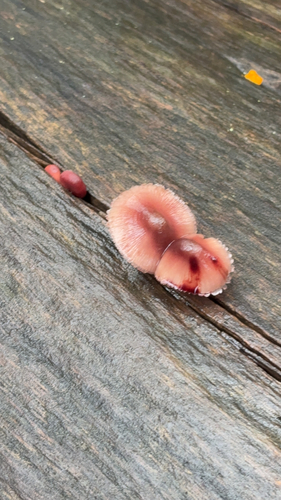
Bleeding Fairy Helmet (Mycena haematopus) is a small wood-decaying mushroom found across North America, growing in clusters on dead hardwood logs and stumps. It is especially noticeable in fall, when it produces reddish liquid if its stem or cap is damaged.
 How to recognize it
Its reddish-brown to purplish, bell-shaped cap and reddish liquid help distinguish it: Mycena galopus releases white liquid, while M. galericulata does not bleed red, M. pura often has a radish-like odor, and M. epipterygia typically has yellowish, sticky surfaces.
 When to see it
Bleeding Fairy Helmet is seen most often in Sep, Oct. There are 39398 public records of it worldwide.
 Questions
It’s seen most often in Sep, Oct.
Its reddish-brown to purplish, bell-shaped cap and reddish liquid help distinguish it: Mycena galopus releases white liquid, while M. galericulata does not bleed red, M. pura often has a radish-like odor, and M. epipterygia typically has yellowish, sticky surfaces.
Do not eat it; wild mushrooms can be difficult to identify, and its edibility is not established.















You may also like

Here to help while we’re tending the farm