

 Open in the Field Guide
We all need a Savior
“For all have sinned and fall short of the glory of God.”
Romans 3:23 (BSB)
None of us can earn our way to God by being good enough. We all need mercy.
 Field Guide · Plants and flowers
Ruscus aculeatus

The sharp stem tips can prick, and the berries should not be eaten because they may cause stomach upset.
Butcher’s-broom is an evergreen shrub native to parts of Europe, western Asia, and North Africa. It grows in shaded woodlands and hedgerows, and is also planted as an ornamental in North America.
 How to recognize it
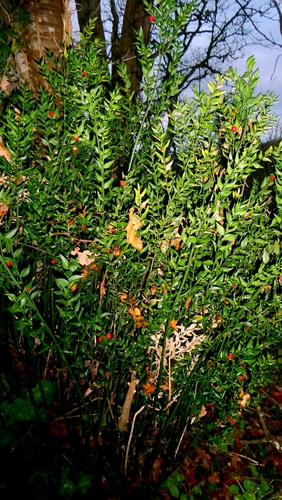
Its stiff, flattened, leaflike stems have sharp tips, with small flowers or red berries growing near the center. Compared with some related Ruscus species, its flattened stems are relatively narrow and sharply pointed.
 When to see it
Butcher's-broom is seen most often in Jan, Mar, Apr, May, Jun. There are 221098 public records of it worldwide.
 Often recorded near
Public records show Butcher's-broom most often in the areas around these farms and places:
Seen one? Point the Lavender Passport Field Guide at it and add your find.
 Questions
It’s seen most often in Jan, Mar, Apr, May, Jun.
Public records show it most often around Agriturismo La Piantata, Azienda Agricola Abbazia di San Giusto, Lavanda della Tuscia, Il Lavandeto di San Marco, Lavanda dei Monti Sibillini.
Its stiff, flattened, leaflike stems have sharp tips, with small flowers or red berries growing near the center. Compared with some related Ruscus species, its flattened stems are relatively narrow and sharply pointed.
The sharp stem tips can prick, and the berries should not be eaten because they may cause stomach upset.















You may also like

Here to help while we’re tending the farm