

 Open in the Field Guide
We all need a Savior
“For all have sinned and fall short of the glory of God.”
Romans 3:23 (BSB)
None of us can earn our way to God by being good enough. We all need mercy.
 Field Guide · Plants and flowers
Salsola tragus

Its sharp leaves and branches can scratch or prick skin, so avoid handling it bare-handed.
Prickly Russian thistle is an annual plant native to Eurasia and introduced widely across North America. It commonly grows in dry, open, disturbed places such as roadsides, fields, and vacant lots; when it dries, the plant can break off and roll in the wind, spreading its seeds.
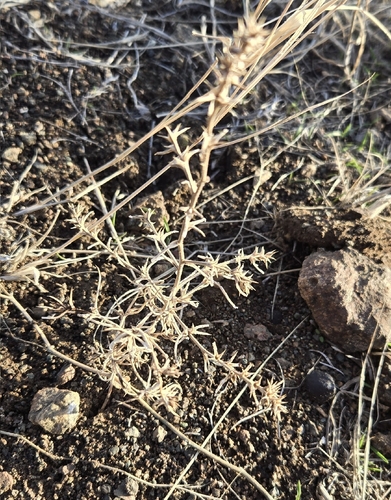
 How to recognize it
Look for branching stems with narrow, stiff leaves that end in sharp points, and small, inconspicuous flowers. It can be difficult to distinguish from the related saltworts listed without examining plant details closely.
 In lavender fields
It may grow as a weed in disturbed or cultivated ground, but has no special relationship with lavender.
 When to see it
Prickly Russian Thistle is seen most often in Jul, Aug, Sep. There are 29766 public records of it worldwide.
 Questions
It’s seen most often in Jul, Aug, Sep.
Look for branching stems with narrow, stiff leaves that end in sharp points, and small, inconspicuous flowers. It can be difficult to distinguish from the related saltworts listed without examining plant details closely.
Its sharp leaves and branches can scratch or prick skin, so avoid handling it bare-handed.















You may also like

Here to help while we’re tending the farm