

 Open in the Field Guide
We all need a Savior
“For all have sinned and fall short of the glory of God.”
Romans 3:23 (BSB)
None of us can earn our way to God by being good enough. We all need mercy.
 Field Guide · Plants and flowers
Echium plantagineum

Do not eat it; its pyrrolizidine alkaloids can poison grazing animals, especially horses.
Salvation Jane, also called purple viper’s-bugloss, is a flowering annual or biennial native to western and southern Europe, North Africa, and southwestern Asia. It grows in open, sunny places such as fields and disturbed ground, and has been introduced to parts of North America, where it can be invasive.
 How to recognize it
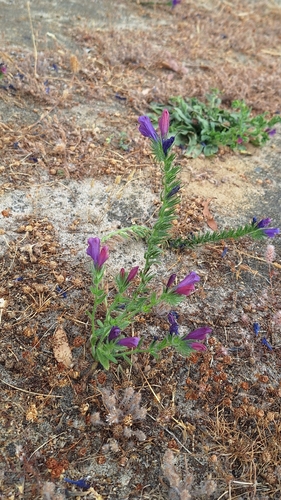
Look for broad, hairy leaves and clusters of purple-blue flowers with stamens that extend beyond the petals. Its broad leaves distinguish it from the narrower-leaved Echium vulgare; Echium italicum has paler flowers, while E. candicans grows as a large shrub.
 In lavender fields
Its flowers provide nectar and pollen for bees, though it can be an invasive weed near gardens and fields.
 When to see it
Salvation Jane is seen most often in Apr, May, Oct, Nov. There are 104153 public records of it worldwide.
 Questions
It’s seen most often in Apr, May, Oct, Nov.
Look for broad, hairy leaves and clusters of purple-blue flowers with stamens that extend beyond the petals. Its broad leaves distinguish it from the narrower-leaved Echium vulgare; Echium italicum has paler flowers, while E. candicans grows as a large shrub.
Do not eat it; its pyrrolizidine alkaloids can poison grazing animals, especially horses.















You may also like

Here to help while we’re tending the farm