

 Open in the Field Guide
We all need a Savior
“For all have sinned and fall short of the glory of God.”
Romans 3:23 (BSB)
None of us can earn our way to God by being good enough. We all need mercy.
 Field Guide · Plants and flowers
Acer pseudoplatanus

Wilted leaves and seeds can seriously poison horses, though ordinary contact is not known to be hazardous to people.
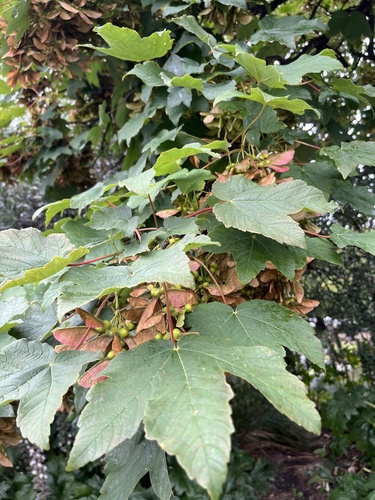
Sycamore maple is a large, deciduous maple native to Central Europe and western Asia. It is also planted and has become naturalized in parts of North America, often growing in parks, woodlands, and disturbed places.
 How to recognize it
Its leaves have five broad, toothed lobes, and mature bark often flakes to reveal lighter patches. The lobes are less sharply pointed than those of Norway maple, and its leaves are broader than the smaller leaves of field maple.
 In lavender fields
Bees visit its spring flowers, but it has no specific relationship to lavender.
 When to see it
Sycamore Maple is seen most often in May, Jun, Jul, Aug, Sep. There are 1353503 public records of it worldwide.
 Questions
It’s seen most often in May, Jun, Jul, Aug, Sep.
Its leaves have five broad, toothed lobes, and mature bark often flakes to reveal lighter patches. The lobes are less sharply pointed than those of Norway maple, and its leaves are broader than the smaller leaves of field maple.
Wilted leaves and seeds can seriously poison horses, though ordinary contact is not known to be hazardous to people.




You may also like

Here to help while we’re tending the farm