

Product Field NotesCompanion Plants
Alexander's White Candytuft: An Evergreen Edge for Lavender Beds
 Save
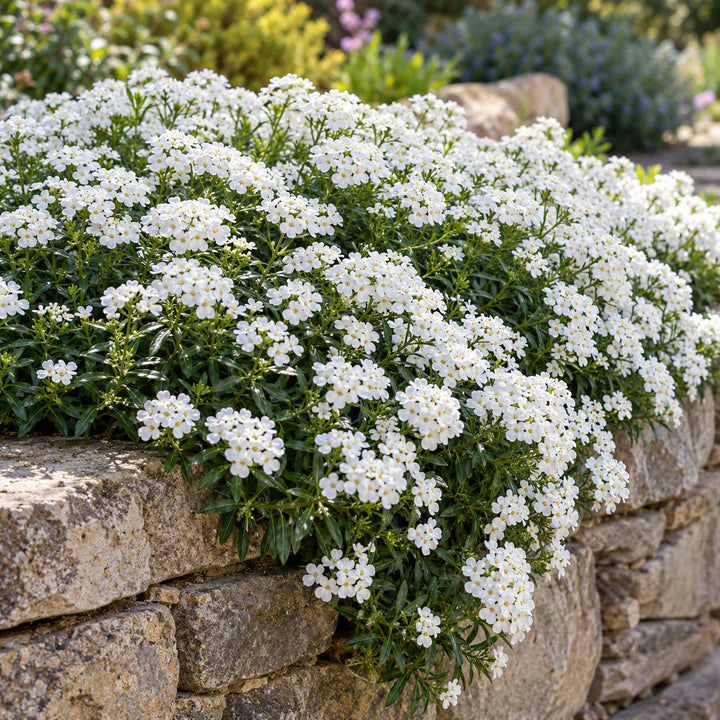
Alexander's White candytuft is a low, fine-textured evergreen that covers itself in flat clusters of pure white, four-petaled flowers from mid to late spring. It tends to start early in the candytuft season, and the flowers come so thickly that the narrow, glossy, dark green leaves almost vanish under them.
After bloom it settles into a tidy dark green cushion that stays green through winter, which is exactly what you want along the front of a lavender bed.
Alexander's White at a glance
| Trait | What to expect |
|---|---|
| Botanical name | Iberis sempervirens 'Alexander's White' |
| Flowers | Pure white, in flat-topped clusters |
| Foliage | Glossy dark green, evergreen |
| Size | 8 to 10 inches tall, 12 to 24 inches wide |
| Bloom | Opens late April, peaks mid-May |
| Hardiness | USDA zones 3 to 9 |
| Light | Full sun |
| Wildlife | Good for early pollinators; moderately deer resistant |
The lavender bed's opening act
A lavender planting does most of its showing off from late June into July. Alexander's White goes first. In late April and May, a ribbon of white along the front edge tells everyone the bed is alive, weeks before the lavender opens. Then, through summer, its dark, glossy green sets off lavender's silver foliage and purple spikes. In winter, when lavender looks gray and quiet, the candytuft is still green.
Candytuft also shares lavender's needs: full sun, sharp drainage and no fuss about dry spells. Use it as edging, spilling over a rock wall, between paving stones or as a small-scale groundcover. Keep it a few inches back from lavender crowns so both get air. Lay out the edge in the Companion Plant Planner.
Planting and care
- Planting: set the bare root plant in spring with the crown at soil level, then water in well.
- Water: regular water until it roots in, then only in long dry spells.
- Shearing: right after bloom, cut the stems back by about a third. This keeps the mat dense instead of leggy.
- Drainage: root and crown rot in wet soil are the main problems. Avoid low spots.
Winter in Michigan
Candytuft is hardy to zone 3, but its evergreen leaves can burn in late winter in exposed spots without snow cover. A light layer of evergreen boughs helps, and any browned tips can be trimmed in spring. In a snowy winter, the snow does the work for you, which is one of the few times we are glad to see it.
Frequently asked questions
Is candytuft a shrub or a perennial?
It is a woody-based evergreen perennial. It stays low and mounded rather than growing into a shrub.
Does it rebloom?
It has one main bloom in spring. Shearing after flowering keeps it neat but does not usually bring a second round.
Can it grow in a container?
Yes, in a well-drained pot it makes a nice spiller around a potted lavender, as long as the pot does not stay wet in winter.

































Share how it went in your field