

Product Field NotesCompanion Plants
Amethyst Kiss Spiderwort: Periwinkle Blooms for Damp Spots
 Save
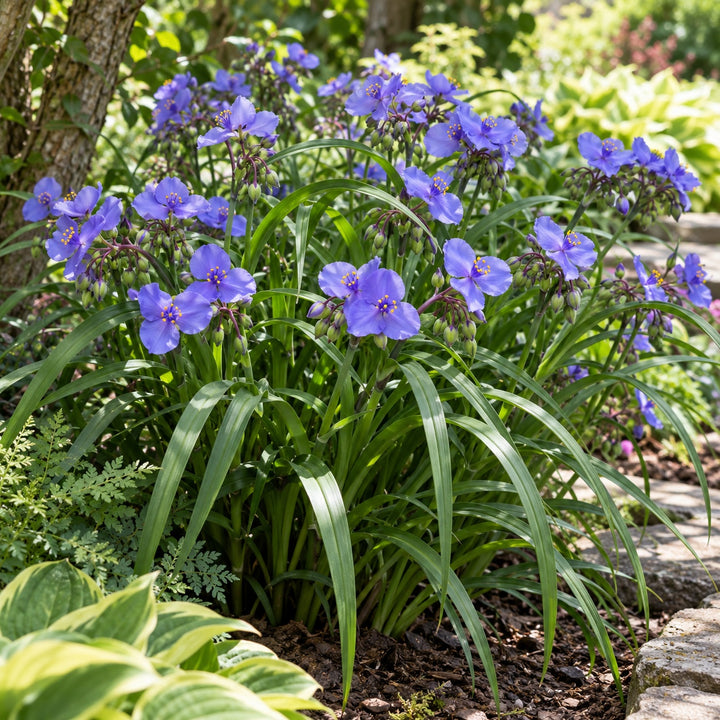
Amethyst Kiss spiderwort is one of the longest-blooming spiderworts around. Large clusters of buds at the stem tips open one after another into three-petaled, periwinkle-blue flowers 1.5 to 2 inches across, each with a fuzzy blue tuft and bright yellow-tipped stamens at the center. It keeps going from early summer into fall, long after most spiderworts have quit.
Amethyst Kiss at a glance
| Trait | What to expect |
|---|---|
| Botanical name | Tradescantia 'Amethyst Kiss' |
| Flowers | Periwinkle blue, three-petaled, yellow-tipped stamens |
| Foliage | Medium green, grass-like and arching |
| Size | 12 to 18 inches tall and wide |
| Bloom | Starts early June, peaks late June, continues into fall |
| Hardiness | USDA zones 3 to 9 |
| Light | Full sun to shade |
| Deer | Moderately resistant |
The wet-spot answer in a lavender garden
Every property with a lavender bed has a place lavender refuses to grow: the low corner where snowmelt collects, the strip by the downspout, the damp edge of a woodland. Amethyst Kiss is happy there. It brings a cool blue-violet that sits in the same color family as lavender, so the wet corner and the dry lavender bed still look like they belong to the same garden.
Its grassy, arching leaves also give a soft, fountain-like texture that contrasts nicely with hostas, ferns or bold-leaved rain garden plants. Use it in native plantings, cottage gardens and along woodland edges. Plan both the dry and damp areas in the Companion Plant Planner.
Planting and care
- Planting: set the bare root plant in spring with the crown at soil level and water it in well.
- Soil: average to fertile with regular moisture. Wet spots are fine.
- Midsummer refresh: if foliage yellows or flops in hot, dry spells, cut the whole plant back by about half. Fresh leaves and more flowers follow.
- Pests: slugs and snails may nibble young growth.
- Winter: fully hardy in Michigan. Cut foliage to the ground in late fall or early spring.
Morning flowers
Each spiderwort flower lasts a single day, and they tend to be at their freshest in the morning. Coffee on the porch is the right time to admire them. By evening the day's blooms have closed, and a new set is waiting in the bud cluster for tomorrow. Because of that, it is a garden plant rather than a cut flower.
Frequently asked questions
Can I plant it next to lavender?
Not in the same soil. It wants regular moisture that lavender would not tolerate. Plant it in a nearby damp or partly shaded spot instead.
Does it spread?
It forms a clump about 12 to 18 inches wide. Divide it in spring if it outgrows its space.
Will it bloom in shade?
It adapts to sun or shade. Expect the most flowers with at least some sun.

































Share how it went in your field