

Product Field NotesLavender Plants
Anouk Lavender: Meet the Spanish Lavender Behind the Whole Family
 Save
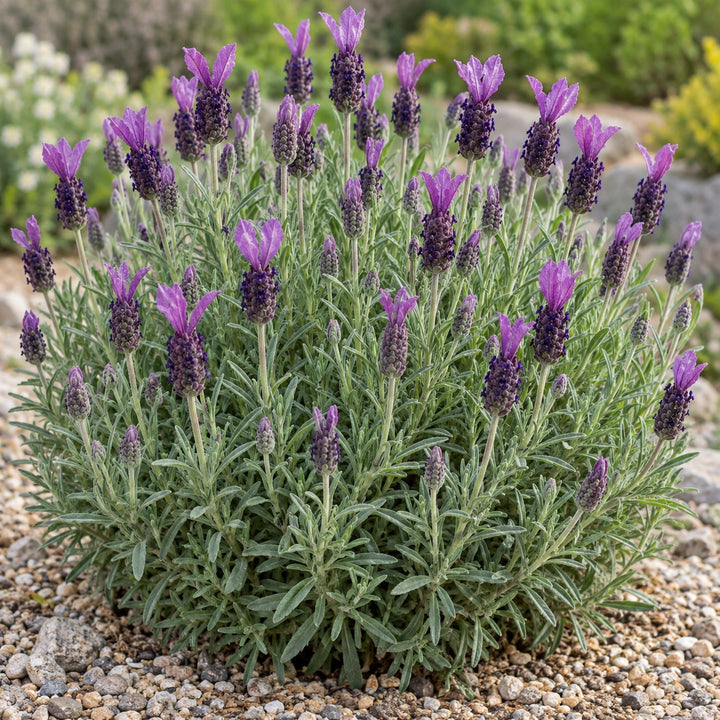
Anouk lavender is the namesake of a whole family of Spanish lavenders, and a good place to start if you have never grown one. It forms a compact, mounding plant about 18 inches tall and 14 inches wide with gray-green leaves, and from early May it carries plump purple heads topped with upright flags. The scent is bold, resinous and a little like rosemary.
It is Lavandula stoechas 'Anouk'. If you know English lavender, think of Anouk as its earlier, showier and less cold-hardy cousin.
Anouk at a glance
| Trait | What to expect |
|---|---|
| Botanical name | Lavandula stoechas 'Anouk' |
| Flower color | Purple, with upright flags |
| Foliage | Gray-green |
| Size | About 18 inches tall and 14 inches wide |
| Habit | Compact and mounding |
| Bloom | Starts early May, peaks early June, high rebloom |
| Hardiness | USDA zones 6a to 9b |
| Fragrance | Strong, resinous and camphor-like |
| Wildlife | Great for pollinators; deer resistant |
Spanish lavender versus English lavender
| Feature | Spanish (Anouk) | English |
|---|---|---|
| Flower shape | Plump heads topped with flags | Slim spikes |
| Bloom | Starts in spring, repeats through the season | Mainly early to midsummer |
| Scent | Bold, piney, camphor-like | Sweet and floral |
| Cold hardiness | Less cold-hardy | Among the hardiest lavenders |
| Kitchen use | Not recommended | The classic culinary lavender |
Neither is better; they do different jobs. Many gardeners grow Anouk in pots for spring color and English lavender in beds for summer and the kitchen.
Planting and care
Plant in full sun, at least six hours a day, in soil that drains quickly. In the ground, choose sandy, gravelly or raised beds and space plants about 14 to 18 inches apart. In containers, use a gritty mix and a pot with a drainage hole. Water deeply when the top of the soil dries, and hold back in cool, wet weather.
- Deadheading: snip faded heads at the base of the stem. Its rebloom rating is high.
- Trimming: a light shear after each big flush keeps the mound full.
- Feeding: little or none in the ground; a light feed once or twice a season for pots.
Winter and hardiness
Anouk is rated for zones 6a to 9b. Spanish lavenders come from warmer, subtropical regions and are generally less cold-hardy than English lavender. At the cold edge of that range, plant it in your warmest, best-drained spot, or keep it in a pot and move it to a cool, bright, frost-free room for winter. The USDA Zone Finder confirms your zone.
Using the flowers
Anouk is grown for color, scent and pollinators. It is rated good for fresh cut flowers and fair for drying, so it shines most in small vases. Culinary use is not recommended.
Choosing a plant format
It is offered as a 3-inch plug, a 4-inch pot or a 1-gallon pot. See the product page for current sizes and availability, and use Notify Me there if it is not available right now. Curious about the rest of the family? The Compare tool lines up the Anouk selections by size, color and bloom.
Frequently asked questions
Why are there so many Anouks?
Anouk is a family of Spanish lavender selections. They share the same look and care but differ in size, flower and bract color, and fragrance strength.
What are the flags on top?
They are bracts, modified leaves that sit above the flower head. They give Spanish lavender its distinctive, rabbit-eared look.
Can I cook with Anouk?
No. Culinary use is not recommended. Choose an English lavender rated for culinary use instead.

































Share how it went in your field