

Use & Care NotesCompanion Plants
Bad Hair Day Mangave: A Tousled, Soft-Leaved Summer Succulent
 Save
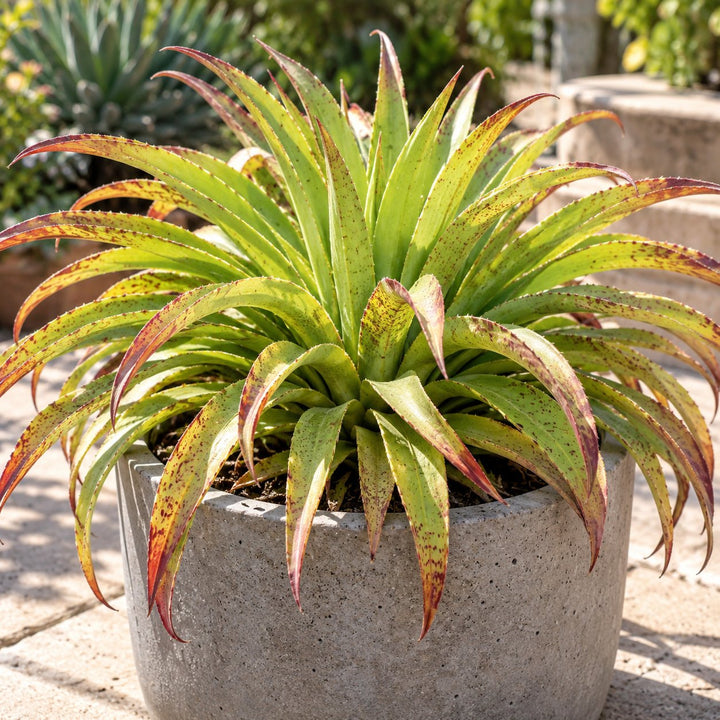
Bad Hair Day mangave looks exactly like its name. Narrow, flat, lime-green leaves about ¾ inch wide arch and splay out in every direction, like a head of hair that lost a fight with the pillow. Each leaf is lightly dotted with blush-red spots that get stronger toward the tips and in bright light. The leaves are soft and flexible, with minimal edge spines and a bendable tip, so it is one of the friendliest mangaves to handle.
Bad Hair Day at a glance
| Trait | What to expect |
|---|---|
| Botanical name | x Mangave 'Bad Hair Day' |
| Foliage | Lime green with blush-red spots, redder at the tips |
| Form | Loose, tousled, arching rosette with soft tips |
| Size | 8 to 16 inches tall, 18 to 36 inches wide as it matures |
| Flowers | Rarely flowers |
| Hardiness | USDA zones 8 to 11 |
| Light | Full sun |
| Deer | Resistant |
Fun in a pot, near the lavender
Mangaves want what lavender wants in summer: full sun and soil that drains in a hurry. Bad Hair Day brings a lighter mood than most. Its lime-green mop is a bright, playful contrast to the silver-gray of lavender, and it looks right at home in a container at the corner of a lavender bed, on a gravel patio or on a sunny step.
It is especially fun in decorative containers, and planters shaped like faces are practically made for it. The leaves become the hairdo. It also mixes well with other succulents and summer annuals. Plan your containers with your beds in the Companion Plant Planner.
Care through the year
- Spring: harden it off gradually when moving outdoors so the leaves do not sunburn.
- Summer: full sun gives the strongest spotting. Water when the mix dries out. It tolerates humid summers and more rain than most agaves if drainage is quick.
- Fall: bring it indoors before nights drop below about 40°F. Check timing with the Frost Date Estimator.
- Winter: a bright window or greenhouse, with sparing water until spring.
Root and crown rot from cold, wet soil is the main risk. Indoors, keep an eye out for mealybugs and scale.
Why the soft leaves matter
Many agave-type plants have sharp spines that make repotting and moving them a careful job. Bad Hair Day is far easier. The flexible leaves and soft tips make it a good choice near walkways, around kids and for anyone who would rather not wear welding gloves to water a plant.
Frequently asked questions
Is it hardy outdoors in Michigan?
No. It is one of the hardier mangaves, but it is still rated only for zones 8 to 11. Overwinter it indoors.
Will it get bigger?
Yes. It can spread to 18 to 36 inches wide as it matures, so give it a roomy pot.
Is it safe to handle?
Its leaves are soft and its tips flexible, so it is much easier to handle than most agaves.
Keep exploring
Ready to plant it?
Sizes, prices and shipping times are on its page.



Share how it went in your field