

Use & Care NotesCompanion Plants
Blue Jean Baby Russian Sage: A Compact Late-Summer Echo of Lavender
 Save
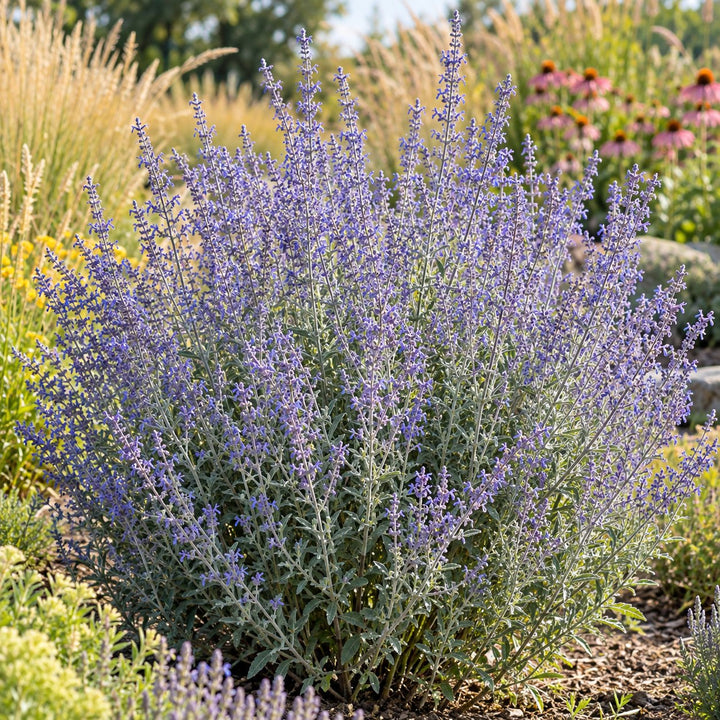
Blue Jean Baby Russian sage is a shorter, bushier Russian sage that fits home gardens far more easily than the classic giant types. It reaches about 28 to 34 inches and is one of the earliest Russian sages to flower, opening violet-blue blooms in midsummer. The flowers sit in smoky purple calyxes that keep their color into fall, so the plant looks in bloom for a long time.
Of all lavender's companions, Russian sage is the one most often mistaken for lavender from across the road. We take it as a compliment.
Blue Jean Baby at a glance
| Trait | What to expect |
|---|---|
| Botanical name | Salvia yangii 'Blue Jean Baby' |
| Flowers | Lavender-blue in smoky purple calyxes on branching spires |
| Foliage | Gray-green to silvery, finely toothed; sharp sage-like scent |
| Size | 28 to 34 inches tall, about 36 inches wide |
| Bloom | Starts mid-July, peaks mid-August, into early fall |
| Hardiness | USDA zones 4 to 9 |
| Light | Full sun |
| Wildlife | Great for pollinators; deer resistant |
The natural successor to lavender
Russian sage and lavender want the same hot sun and lean, sharp-draining soil. They also share a look: silvery foliage, aromatic leaves and blue-violet spires. The difference is timing. English lavender peaks in late June and July. Blue Jean Baby starts in mid-July and peaks in mid-August, then holds color into fall thanks to those smoky calyxes. Plant the two together and the bed slides from lavender season into Russian sage season without a dull stretch.
Its compact, upright habit is the real improvement. Older Russian sages often sprawl over their neighbors by August. Blue Jean Baby's stems stay erect, so it can sit right behind or between lavender plants without flopping onto them.
Pruning at the right time
Do not prune Russian sage in fall. Leave the stems standing over winter, where they add structure and catch snow. In spring, once new buds show along the lower stems, cut back to just above the lowest set of new growth, roughly 6 to 12 inches from the ground. It is slow to leaf out, so be patient before deciding a stem is dead.
Planting and care
- Site: full sun, the hotter and more exposed the better.
- Soil: lean to average and well drained. It dislikes wet feet.
- Water: regularly until established, then it thrives on drought.
- Feeding: none needed.
- Deadheading: not required.
Plug tray or bare root
Blue Jean Baby is offered as a 72-cell plug tray for growers, mass plantings and long borders, and as a bare root plant for home gardens. See each product page for current availability and the Wholesale Hub for tray orders.
Frequently asked questions
Is Russian sage related to lavender?
Both are in the mint family, and Russian sage is now classified as a salvia. They are different plants with very similar needs.
Can I cook with it?
No. It is ornamental. Use culinary lavender or culinary sage in the kitchen instead.
Does it dry well?
Yes. The spires dry nicely for arrangements and hold their smoky purple tone.
Keep exploring
Ready to plant it?
Sizes, prices and shipping times are on its page.





Share how it went in your field