

Product Field NotesCompanion Plants
Bottle Rocket Ligularia: Yellow Spires for Wet, Shady Ground
 Save
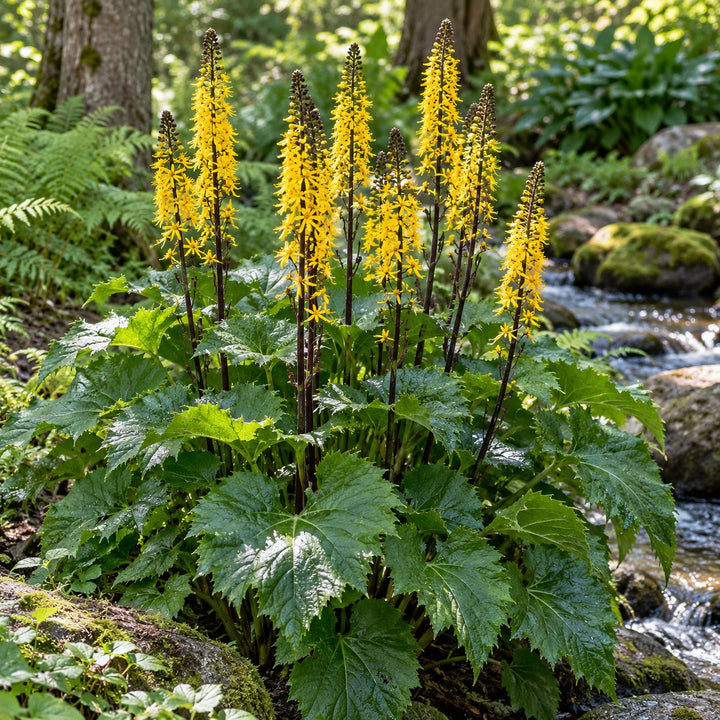
Bottle Rocket ligularia forms a dense clump of thick, toothed green leaves, and in midsummer it sends up a bundle of narrow mustard-yellow flower spikes on dark chocolate stems. The spikes cluster in the center of the plant, so it looks like someone set a bouquet in the middle of the foliage.
It is a compact ligularia, smaller and denser than many, and it holds up in summer heat better than most of its relatives. Even so, it is a plant for wet shade, and it is about as far from lavender's needs as a perennial can get.
Bottle Rocket at a glance
| Trait | What to expect |
|---|---|
| Botanical name | Ligularia 'Bottle Rocket' |
| Flowers | Mustard-yellow spikes on dark chocolate-brown stems |
| Foliage | Large, thick, serrated green leaves |
| Size | 28 to 34 inches tall in bloom, 24 to 28 inches wide |
| Bloom | Starts early July, peaks mid-July |
| Hardiness | USDA zones 4 to 9 |
| Light | Part shade, with afternoon shade |
| Deer | Resistant |
Where it fits in a lavender garden plan
Every property has a spot that stays wet: a low corner where the downspout drains, the edge of a pond, the soggy strip along a shaded fence. That is exactly the ground lavender hates and Bottle Rocket loves. Planting it there solves a problem area while your lavender stays up on the dry, sunny beds where it belongs.
Its yellow spikes bloom in midsummer, around the same time lavender is in color, so the two corners of the garden peak together. In the damp shade bed, pair it with hostas and ferns; the bold ligularia leaves and upright spikes give that bed the vertical accent lavender gives the sunny side. Use the Companion Plant Planner to plan both zones on one map.
Planting and care
- Light: morning sun with afternoon shade is ideal. The leaves wilt quickly in hot afternoon sun, even in moist soil.
- Soil: rich and consistently moist. This is one of the few perennials that likes boggy ground.
- Water: deeply in summer, especially in heat waves. Do not let it dry out.
- Slugs: the main pest. Check young leaves in damp springs.
- After bloom: cut spent spikes back to the foliage.
- Fall: keep it evenly moist into fall, cut the foliage down after frost and mulch to protect the crown.
A little afternoon wilting on a hot day is normal for ligularia and often recovers by evening. Leaves that stay limp in the morning mean it needs more water or more shade.
Containers
Its compact size makes Bottle Rocket one of the better ligularias for large containers on a shaded patio. Use a big pot, rich potting mix and plan on frequent watering, since pots dry out faster than ground soil.
Ordering format
Bottle Rocket is offered as a 72-cell plug tray, a good option for planting out a rain garden or a long damp border. See the product page for current availability, or the Wholesale Hub for tray orders.
Frequently asked questions
Why do the leaves collapse in the afternoon?
Ligularia loses water through its large leaves faster than its roots can replace it in hot sun. More shade in the afternoon and steady moisture are the fix.
Do bees visit it?
It has good pollinator value, so expect some visitors to the yellow spikes in midsummer.

































Share how it went in your field