

Product Field NotesCompanion Plants
Candy Floss Pink Muhly Grass: A Rose-Pink Haze for Fall
 Save
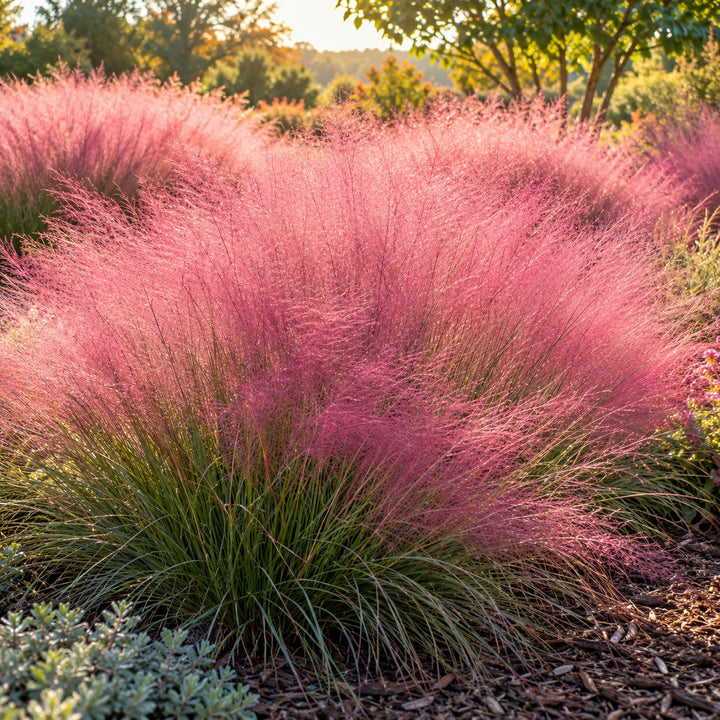
Candy Floss pink muhly grass forms a dense, rounded clump of thread-fine green leaves about two feet tall. In early fall, hair-fine flower panicles rise to three to three and a half feet and wrap the plant in a cloud of deep rose pink that glows when the sun shines through it, then fades to soft tan later in fall.
It thrives in the same full sun and lean, dry soil as lavender, and its pink haze arrives in September, weeks after the lavender has been harvested. It blooms earlier than typical pink muhly and overwinters better in northern gardens than standard forms, though it is still rated to zone 6.
Candy Floss at a glance
| Trait | What to expect |
|---|---|
| Botanical name | Muhlenbergia capillaris 'Candy Floss' |
| Flowers | Airy deep rose-pink clouds, fading to tan |
| Foliage | Very fine, thread-like green leaves |
| Size | 36 to 42 inches tall in bloom, about 44 to 48 inches wide |
| Bloom | Early to mid-September |
| Hardiness | USDA zones 6 to 10 |
| Light | Full sun |
| Deer | Resistant |
A fall follow-up to lavender
Lavender's main show is in early to midsummer. By September, the bed is mostly silver foliage. Candy Floss fills that late-season space with soft pink that pairs beautifully with lavender's gray-green leaves and any late lavender rebloom. Plant it where the low autumn sun will backlight the flower clouds, such as along the west side of a bed or a path you walk in the evening.
It gets wide, close to four feet, so give it room at the back or ends of a lavender planting, or mass it in a separate drift nearby. Use the Companion Plant Planner to check spacing.
Getting it through a Michigan winter
Candy Floss is rated to zone 6, which makes it borderline in colder parts of Michigan. Check your zone with the USDA Zone Finder. To give it the best chance:
- Plant in spring so it has a full season to root in.
- Choose sharply drained soil. Crown rot in wet winter soil is the main cause of loss, the same risk lavender faces.
- Leave the foliage and seed heads standing until spring; they help protect the crown.
- Cut back in early spring once new growth is about to start.
Care through the season
Once established, it has excellent heat and drought tolerance and few disease problems. Water through its first summer, then let it be. Skip fertilizer, which works against both the grass and the lavender beside it.
Ordering format
Candy Floss is offered as a 72-cell plug tray, ideal for mass plantings where the pink haze has the most impact. See the product page for current availability, or the Wholesale Hub for tray orders.
Frequently asked questions
Do pollinators use it?
Its pollinator value is low. It is grown for its fall color and texture.
Can I cut it for arrangements?
It is fair for both fresh and dried use. The airy pink stems add softness to fall bouquets with dried lavender.

































Share how it went in your field