

Product Field NotesCompanion Plants
Caramel Coral Bells: Warm Amber Foliage at the Lavender's Edge
 Save
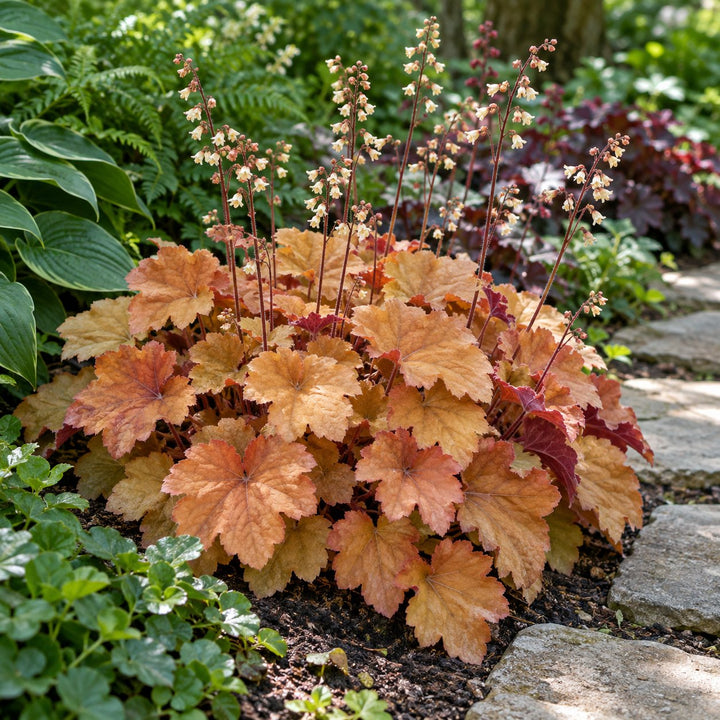
Caramel coral bells is grown for its leaves, and they are worth it. New growth opens soft apricot and matures to honey amber, and the slightly fuzzy leaves flip in the wind to show purple-red undersides. It is a vigorous, reliable plant with a heat-tolerant Heuchera villosa background.
It can sit near lavender but not in the thick of it. Caramel needs more even moisture than lavender likes, so its best spot is the lightly shaded edge of a bed, or a nearby border where the sun gives way to shade.
Caramel at a glance
| Trait | What to expect |
|---|---|
| Botanical name | Heuchera 'Caramel' |
| Foliage | Apricot to amber with purple-red undersides; evergreen to semi-evergreen |
| Flowers | Small cream bells on stems about 14 inches tall |
| Size | About 12 inches tall, 12 to 20 inches wide |
| Bloom | Starts late June, peaks mid-July |
| Hardiness | USDA zones 4 to 9 |
| Light | Full sun to full shade; brightest color with morning sun and afternoon shade |
| Deer | Moderately resistant |
Where it meets the lavender
Warm amber and cool silver are a striking pair. Set Caramel at the shady end of a lavender border, where the last lavender plant still gets full sun and the coral bells get a break from afternoon heat, and the colors bounce off each other. It also works where a path runs from a sunny lavender bed into a shaded one.
Do not tuck it right between lavender mounds. The regular water Caramel wants would keep lavender roots too wet. Give each plant its own watering zone, even if they are only a few feet apart. The Companion Plant Planner is handy for working out those transitions.
Planting and care
- Planting depth: set the crown at soil level, not buried and not perched.
- Soil: average to fertile and well-drained. Winter wet causes crown rot, the main problem for coral bells.
- Water: regularly, especially in its first year and in hot spells.
- Watering habit: water at the base and avoid wetting the leaves late in the day.
- Flowers: sparse and small. Many gardeners snip the stems to keep attention on the leaves.
- Winter: frost heaving is common in heavy soil. Mulch after the ground freezes, press heaved crowns back in spring and trim tattered leaves.
Containers and edging
At about a foot tall, Caramel is easy to slip into container combinations, where its color plays well with purple, chartreuse and silver. Lined along a partly shaded path, a row of it reads as a ribbon of warm caramel-orange from spring to fall.
Plug tray sizes
Caramel is offered as a 72-cell plug tray and a 20-cell plug tray. The 72-cell tray suits growers and large plantings; the 20-cell tray gives bigger plugs that size up sooner. See each product page for current availability, or visit the Wholesale Hub.
Frequently asked questions
Can Caramel take full sun?
It can grow in sun, but the leaf color is best with afternoon shade, and full sun means more watering.
Why are my coral bells heaving out of the ground?
Freeze and thaw cycles push the shallow crowns up. Mulch after the ground freezes and press plants back in early spring.

































Share how it went in your field